Provenance
Marmontel (label on old backing); Bradlay (name inscribed on old backing, in graphite); Shepherd Gallery, October 1976
Accession Number
2010.167
Medium
black chalk heightened with white chalk
Dimensions
Sheet: 40.9 x 31.6 cm (16 1/8 x 12 7/16 in.)
Classification
Drawing
Credit Line
Bequest of Muriel Butkin
Tags
Drawing Neoclassical & Romantic (1751–1850) French Color: Brown
Background & Context
Background Story
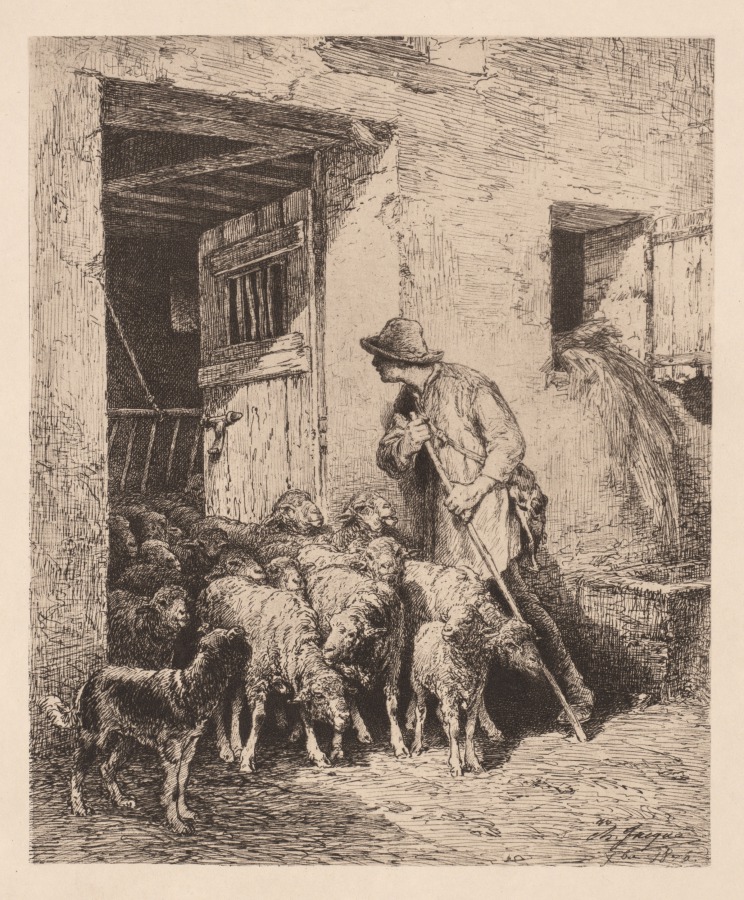
Bringing in the Sheep (1800s) depicts the daily ritual of returning the flock from pasture to the fold—one of the most visually striking moments in the sheep-farming cycle. The bringing-in subject, typically occurring at dusk, provided Jacque with the atmospheric opportunities that Barbizon painting cherished: the fading light, the shepherd's silhouette against the evening sky, and the flock's movement toward the fold created scenes of extraordinary pictorial beauty. The daily round-trip—out to pasture in the morning, back to the fold in the evening—was the fundamental rhythm of pastoral life, and Jacque's depiction of the evening return captures this rhythm at its most visually evocative moment. His treatment of the sheep—their movement as a group, their response to the shepherd's direction, and their characteristic behavior when returning to shelter—demonstrates the ethnographic precision that distinguished his animal painting from more generalized treatments. The landscape setting, rendered in the atmospheric Barbizon style with its characteristic attention to the quality of evening light, provides the environmental context that gives the bringing-in ritual its emotional resonance. The painting connects the daily cycle of pastoral work to the larger cycles of nature—day and night, season and season—that gave Barbizon landscape painting its philosophical depth.
Cultural Impact
Jacque's bringing-in paintings influenced how the daily cycle of rural work was represented in Barbizon art, capturing the most atmospheric moments of the pastoral routine. The paintings influenced later painters who similarly found beauty in the evening rituals of agricultural work. The bringing-in subject influenced how the temporal dimension of rural life was represented, connecting daily routine to natural cycles.
Why It Matters
This painting matters because it captures the pastoral day's most evocative moment—the evening return from pasture, when the fading light and the flock's movement create scenes of both practical and poetic significance. The bringing-in ritual, repeated daily across millennia, represents the agricultural cycle's permanence that Jacque's painting preserves alongside the specific breeds, techniques, and landscapes of 19th-century France.