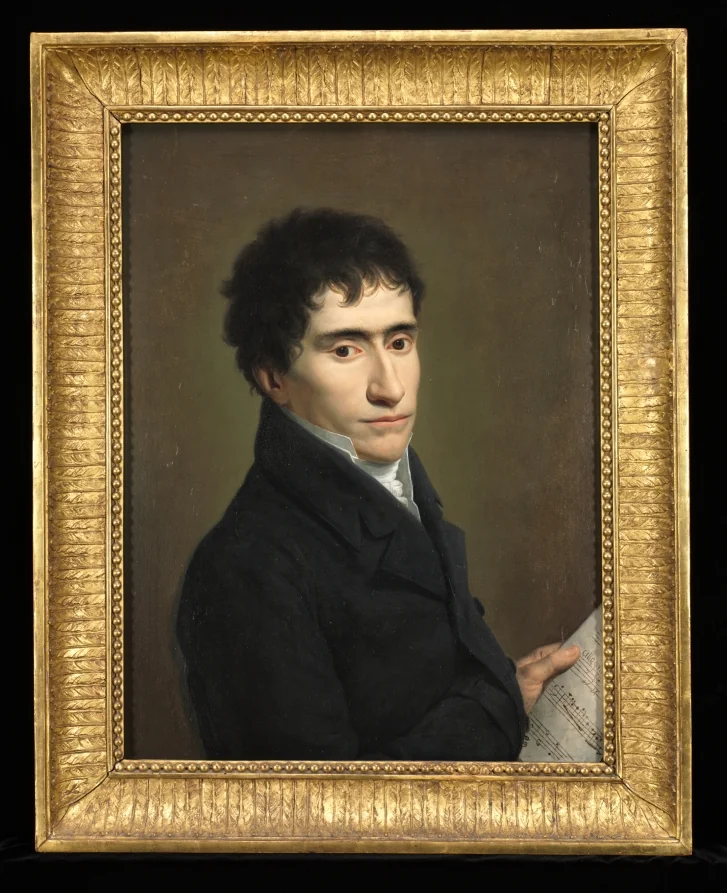
Description
This unsigned panel depicts an unidentified musician, seen at half-length. He holds a score, which is legible, but not yet identified. The man wears a black coat; plain, high-collared white shirt, and a white cravat, a style broadly fashionably among European elite and bourgeois men in the years around 1800.
Provenance
Hazlitt Gallery (London, England), sold to Paul J. Vignos, Jr., 1974; Paul J. Vignos, Jr., 1974-2010; [died 2010 (Gates Mills, Ohio)], upon his death, held in trust by the estate; Estate of Paul J. Vignos, Jr., 2010; The Cleveland Museum of Art
Accession Number
2011.46
Medium
oil on wood
Dimensions
Framed: 72 x 57 x 6.5 cm (28 3/8 x 22 7/16 x 2 9/16 in.); Unframed: 43.8 x 60.3 cm (17 1/4 x 23 3/4 in.)
Classification
Painting
Credit Line
Bequest of Dr. Paul J. Vignos Jr.
Tags
Painting Neoclassical & Romantic (1751–1850) Oil Painting Italian Color: Gold
Background & Context
Background Story
Andrea Appiani's "Portrait of a Musician" (c. 1800) depicts an unidentified man holding a musical score — a composition that places the subject's professional identity at the center of his portrait. The musician wears a black coat with a plain, high-collared white shirt and white cravat, a style of dress that was broadly fashionable among European elite and bourgeois men in the years around 1800, reflecting the influence of English neoclassical simplicity over the more ornate fashions of the ancien régime.
Appiani (1754–1817) was the leading Neoclassical painter in Milan during the Napoleonic era and the official court painter to Napoleon in Italy. He is best known for his large-scale frescoes in the Palazzo Reale in Milan and the Villa Belgioioso, as well as for his portraits of the Napoleonic elite. His style combined the compositional rigor and drawing clarity of the Neoclassical tradition — learned from his study of Raphael and antique sculpture — with a Venetian sensitivity to color that distinguished his work from the more austere Neoclassicism of David and his French followers.
This portrait is notable for its restraint and psychological focus. Rather than surrounding the sitter with the attributes of wealth and status favored by Baroque and Rococo portraitists, Appiani strips the composition to its essentials: a face, a pose, a musical score. The dark background eliminates all distraction, focusing the viewer's attention entirely on the musician's thoughtful expression and the score he holds. The score itself, though legible, has not yet been identified — a tantalizing clue that suggests the sitter may yet be identified through musical scholarship.
The portrait dates from the period of Appiani's greatest influence. As Napoleon's official painter in Italy, Appiani was responsible for creating the visual iconography of Napoleonic rule — painting the emperor in classical poses, designing decorations for public ceremonies, and portraying the Italian figures who embraced the new political order. Yet this portrait of an unidentified musician suggests that Appiani also maintained a private practice of more intimate portraits, where he could exercise his skill at psychological observation without the demands of official iconography.
Appiani's later years were marked by tragedy. In 1815, after Napoleon's fall, he suffered a severe stroke that left him partially paralyzed and unable to paint. He died in 1817, having witnessed the destruction of the political order he had served and helped to visualize. This portrait of a musician, made during his years of confidence and influence, preserves a moment of artistic and political optimism that would not survive the Napoleonic collapse.
Cultural Impact
As Napoleon's chief painter in Italy, Appiani created the visual language of Napoleonic rule in Milan, combining Neoclassical rigor with a Venetian color sense that distinguished Italian Neoclassicism from its French counterpart.
Why It Matters
This portrait of an unidentified musician demonstrates Appiani's ability to combine Neoclassical restraint with genuine psychological observation — a private meditation on the creative life made during his years of public triumph.
![Saint Bernard and Saint Catherine of Alexandria with the Virgin of the Annunciation [right panel]](https://api.nga.gov/iiif/e6890364-4d99-4684-a62b-5060ee3c3446/full/400,/0/default.jpg)