Provenance
Mr. Charles W. Gould, NY; (E. & A. Milch, Inc., New York); Solton Engel, New York; wife, Julia Engel by bequest, New York; gift to NGA, 1984
Accession Number
1984.58.3
Medium
transparent and opqaue watercolor over graphite on wove paper
Dimensions
overall: 69.5 x 48.9 cm (27 3/8 x 19 1/4 in.)
Classification
Drawing
Credit Line
Bequest of Julia B. Engel
Tags
Drawing Impressionist & Modern (1851–1900) Watercolor Graphite & Pencil Paper American Color: White
Background & Context
Background Story
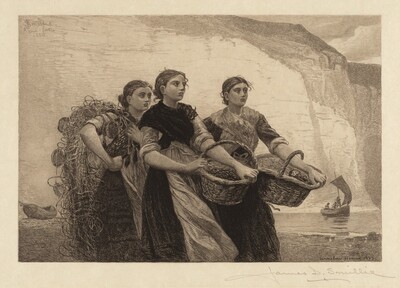
Mending the Nets (1882) depicts a subject Homer knew intimately from his years in the fishing community of Cullercoats, England (1881-82), where he observed the lives of fisherwomen with the intensity that transformed his art. The Cullercoats experience was the pivotal event in Homer's career: it moved him from illustration-style genre painting to the monumental treatment of maritime life that defines his mature work. Net mending—a routine maintenance activity—was essential to fishing communities' survival and was traditionally women's work, performed onshore while men were at sea. Homer's painting captures this gendered division of labor with characteristic directness, finding dignity in the routine work that sustained the fishing economy. The year 1882 places this work at the end of the Cullercoats period, when Homer was returning to America with a transformed artistic vision. The painting's handling likely shows the influence of Cullercoats on Homer's style: heavier figures, more monumental treatment, and a somber palette that reflects the northeast English coast's austere beauty. Net mending, as a subject, allowed Homer to combine still-life precision (the nets' intricate structure) with figure painting and landscape observation—a synthesis of genres that characterizes his best work.
Cultural Impact
Homer's Cullercoats-influenced paintings transformed American maritime art, introducing a gravity and monumentality that distinguished his work from the more sentimental seacoast genre painting that preceded him. The paintings influenced how American fishing communities were represented, establishing a visual tradition of maritime gravity that influenced later realist painters. The fisherwoman subject influenced how women's economic contributions to maritime life were represented in art.
Why It Matters
This painting matters because it represents the moment when Homer's art achieved its mature power. The Cullercoats experience transformed a talented illustrator into a major artist, and Mending the Nets captures this transformation in progress—the direct observation, the formal gravity, and the unsentimental treatment of working life that would define Homer's subsequent career.