Accession Number
1987.59.1
Medium
watercolor over graphite on wove paper
Dimensions
overall: 33.4 x 23.3 cm (13 1/8 x 9 3/16 in.)
Classification
Drawing
Credit Line
Ailsa Mellon Bruce Fund
Tags
Drawing Neoclassical & Romantic (1751–1850) Watercolor Graphite & Pencil Paper British
Background & Context
Background Story
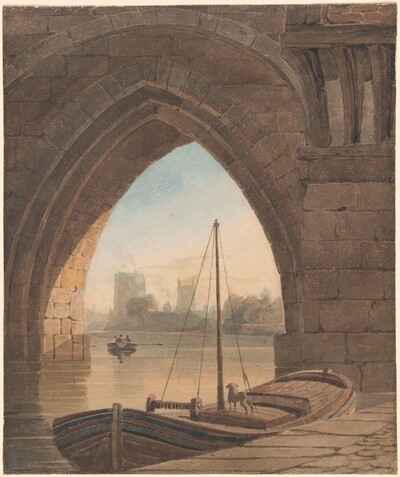
John Varley (1778-1842) was an English watercolor painter and astrologer, a founding member of the Society of Painters in Water Colours (later the Royal Watercolour Society) who championed the watercolor medium as an independent art form. Pont Aberglaslyn from 1812 depicts a bridge in North Wales in the topographical watercolor manner that Varley developed in his Welsh tours of the early 19th century. The Welsh landscape was one of the most popular subjects for English watercolor painters in the Romantic period, and Varley's Pont Aberglaslyn combines the topographical precision of the watercolor tradition with the picturesque atmosphere that the Welsh landscape inspired.
Cultural Impact
Pont Aberglaslyn is important in the history of English watercolor painting because it demonstrates Varley's role in establishing watercolor as an independent art form. As a founding member of the Society of Painters in Water Colours, Varley championed the watercolor medium against the Royal Academy's prejudice that considered it a preparatory medium rather than an independent art form, and his Welsh landscapes demonstrate that watercolor could produce works of the same artistic quality as oil painting.
Why It Matters
Pont Aberglaslyn is Varley championing watercolor as independent art: a Welsh bridge in the topographical yet atmospheric watercolor manner that he developed to demonstrate watercolor's artistic equality with oil. The 1812 painting shows the Welsh landscape that inspired the English watercolor tradition at its most productive period.