
Provenance
Pierre Bonnard [1867-1947]; (his estate sale, Galerie Charpentier, Paris, 23 February 1954, no. 30). Sir Alexander Korda; (his sale, Sotheby's, London, 14 June 1962, no. 31); purchased through (Hector Brame, Paris) by Mr. Paul Mellon, Upperville, VA;[1] gift 1995 to NGA.
[1]See Paul Mellon files now in NGA curatorial records.
Accession Number
1995.47.13
Medium
oil on cardboard
Dimensions
overall: 41.7 x 31.9 cm (16 7/16 x 12 9/16 in.) | framed: 63.5 x 53.3 x 5.4 cm (25 x 21 x 2 1/8 in.)
Classification
Painting
Credit Line
Collection of Mr. and Mrs. Paul Mellon
Tags
Painting Impressionist & Modern (1851–1900) Oil Painting Board French
Background & Context
Background Story
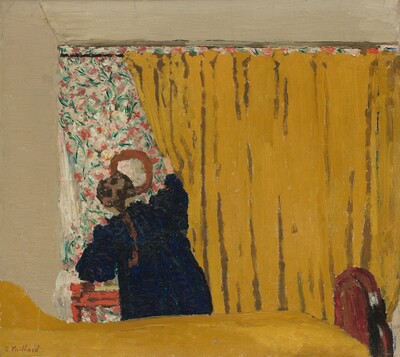
Madame Bonnard (1895/1900) depicts the mother of Pierre Bonnard—Vuillard's fellow Nabi and lifelong friend. The Bonnard and Vuillard families were intimately connected: both artists lived with their mothers, both worked in domestic interiors, and both were central figures in the Nabi movement's engagement with domestic subject matter. Madame Bonnard, as a subject, connects Vuillard's art to the broader domestic world of the Nabi painters—a community of artists who found their subjects in the intimate spaces of daily life. The 1895-1900 date spans the period when the Nabi movement was at its most productive and when Vuillard's Intimist style was reaching its fullest development. His treatment of Madame Bonnard likely emphasizes the domestic setting—the patterned surfaces, the particular quality of interior light, and the material culture of the bourgeois apartment that was his characteristic milieu. Vuillard's integration of figure and setting—where the sitter becomes an element within the room's overall pattern rather than standing apart from it—distinguishes his portraiture from more conventional approaches that isolate the sitter from their environment. The painting thus argues that people are defined by their domestic surroundings as much as by their physical features, and that portraiture's task is to capture this environmental identity.
Cultural Impact
Vuillard's portrait of Madame Bonnard influenced how domestic portraiture was practiced in the Nabi tradition, integrating sitters into their domestic settings rather than isolating them. The painting influenced how the Vuillard-Bonnard friendship was understood, documenting the artistic and personal connections between the two Nabi painters. The portrait influenced how mothers of artists were represented in modern art, connecting domestic authority to artistic practice.
Why It Matters
This painting matters because it captures the interconnected domestic world of the Nabi painters—the families, apartments, and material cultures that sustained both Vuillard's and Bonnard's art. Madame Bonnard is not merely a portrait subject; she is the mother of the artist's closest friend, and her presence in Vuillard's work documents the intimate community that produced some of the most original paintings of the 1890s.
![Program Design for the Théâtre Libre [recto]](https://api.nga.gov/iiif/f8458b78-b7bf-4bb1-aa54-069a9696efaa/full/400,/0/default.jpg)
![Program Design for the Théâtre Libre [verso]](https://api.nga.gov/iiif/e47d4a71-21c6-4d88-abe5-e889394e0cc5/full/400,/0/default.jpg)