Provenance
Commissioned 1879 by Edouard Pailleron, Chambéry, France; by descent 1899 to his daughter, Marie-Louise Pailleron; by descent 1950 to her son, Henri Bourget-Pailleron; his widow; purchased 1964 by the Corcoran Gallery of Art, Washington; acquired 2014 by the National Gallery of Art.
Accession Number
2014.79.53
Medium
oil on canvas
Dimensions
overall: 211.2 × 104.4 cm (83 1/8 × 41 1/8 in.) | framed: 246.7 × 139.07 × 15.88 cm (97 1/8 × 54 3/4 × 6 1/4 in.)
Classification
Painting
Credit Line
Corcoran Collection (Museum Purchase and gifts of Katherine McCook Knox, John A. Nevius and Mr. and Mrs. Lansdell K. Christie)
Tags
Painting Impressionist & Modern (1851–1900) Oil Painting Canvas American Color: Gray
Background & Context
Background Story
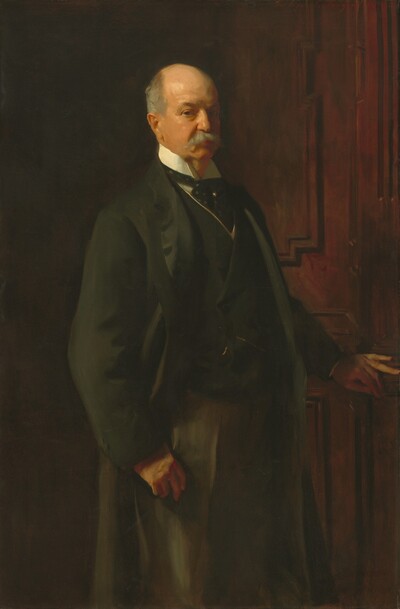
Marie Buloz Pailleron (Madame Édouard Pailleron) (1879) is one of Sargent's earliest significant portraits, depicting the wife of the playwright Édouard Pailleron and the daughter of François Buloz, the founder of the Revue des Deux Mondes—one of the most influential literary magazines in France. The 1879 date places this during Sargent's early Paris period, when he was studying under Carolus-Duran and developing the portrait method that would make him famous. Madame Pailleron's portrait demonstrates the method that Carolus-Duran had taught Sargent: the direct approach, working from the general to the specific, and the emphasis on tonal values over linear drawing that gave Sargent's portraits their characteristic authority. Her expression—intelligent, knowing, and slightly apprehensive—reveals the personality behind the social facade with an honesty that would become Sargent's signature. The portrait also documents the Parisian literary world at a specific historical moment: the Pailleron salon, where writers, artists, and intellectuals gathered, was one of the most significant cultural institutions of the Third Republic, and Sargent's portrait preserves the presence of one of its most important figures.
Cultural Impact
Sargent's early Paris portraits influenced how French literary society was represented in art, documenting the cultural institutions of the Third Republic. The portraits influenced how Sargent's development was understood, revealing the Carolus-Duran method that preceded his mature style. Madame Pailleron influenced how intellectual women were represented in portraiture, connecting literary authority to social presence.
Why It Matters
This painting matters because it captures one of the most significant figures in Parisian literary society with the characterization that Sargent's early portraits were already achieving—Madame Pailleron is not merely a likeness but a presence, and the presence revealed is that of a woman whose intelligence and cultural authority made her one of the most important figures in the Third Republic's literary world.