Provenance
Possibly John Ingram [1767-1841], Matsala [or Marsala] House, England;[1] probably passed to his son Hughes Ingram [b. c. 1800]; probably passed to his nephew Ingram Fuller Godfrey [1827-1916].[2] John G. Johnson, Philadelphia; purchased 1894 by Peter A. B. Widener, Lynnewood Hall, Elkins Park, Pennsylvania;[3] inheritance from Estate of Peter A. B. Widener by gift through power of appointment of Joseph E. Widener, Elkins Park, Pennsylvania; gift 1942 to NGA.
[1] _Catalogue of Paintings Forming the Private Collection of P.A.B. Widener, Ashbourne, near Philadelphia. Part II. Early English and Ancient Paintings_, Paris, 1885-1900: 202, gives the provenance as "Ingram (Marsala House) Collection." A typewritten copy of the same catalogue, dated 1908 on the binding (NGA library, Rare Book Collection), changes "Marsala" to "Matsala." Subsequent Widener catalogues (1916, 1923, and 1931) give the provenance as Matsala House. The probable pendant (see text of the NGA systematic catalogue entry) is listed in the _Catalogue of a Collection of Pictures Belonging to John G. Johnson_, Philadelphia, 1892: 86, no. 257, as coming from "Ingram of Marsala House." Ingram has not been identified conclusively, but would appear to be John Ingram, who is known to have collected Guardi views in Venice around 1800. On John Ingram see Francis Haskell, "Francesco Guardi as _Vedutista_ and Some of His Patrons", _Journal of the Warburg and Courtauld Institutes_ 23 (1960): 271-272. In a letter of 17 September 1968 (NGA curatorial files), Haskell wrote that he was baffled by the reference to Matsala House. John Ingram is known to have resided at Staindrop Hall, County Durham; in Venice; and later in Rome.
[2] The later history of John Ingram's collection is traced by James Byam Shaw, "Some Guardi Drawings Rediscovered", _Master Drawings_ 15 (1977): 3-5. Parts of Ingram's collection were dispersed at the end of the nineteenth century in public sales that did not include paintings. Johnson may have acquired the Washington and Philadelphia paintings directly or indirectly from Ingram's heirs at about this time, but this cannot be documented.
[3] According to a typewritten card in the Lynnewood Hall Inventories, NGA curatorial files. The painting does not appear in the 1892 Johnson catalogue cited in note 1.
Accession Number
1942.9.27
Medium
oil on canvas
Dimensions
overall: 68.5 x 91.5 cm (26 15/16 x 36 in.)
Classification
Painting
Credit Line
Widener Collection
Tags
Painting Neoclassical & Romantic (1751–1850) Oil Painting Canvas Italian Color: Orange Color: Gray
Background & Context
Background Story
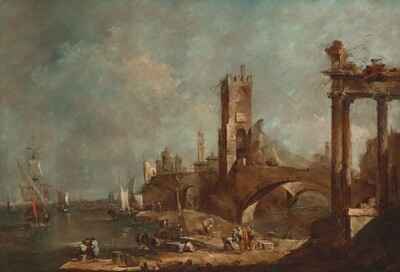
Francesco Guardi's view of the Grand Canal with the Rialto Bridge captures Venice at the height of its late republican splendor, yet tinged with the melancholy of a republic in slow decline. Painted around 1780, this veduta (view painting) belongs to the tradition established by Canaletto, but Guardi transforms the precise architectural records of his predecessor into something more atmospheric and emotionally resonant. The Rialto Bridge—the commercial heart of Venice since its construction in 1591—stands as the composition's anchor, its arcades bustling with the mercantile activity that had sustained the Republic for centuries. Guardi renders the canal's surface with loose, rapidly applied brushwork that dissolves the reflections of buildings into shimmering color, creating an effect Canaletto would never have attempted. By the 1780s, Venice's political independence was living on borrowed time—Napoleon would extinguish the Republic in 1797—and Guardi's shimmering, unstable surfaces seem to intuit this fragility. The painting records not just what Venice looked like but what it felt like: magnificent yet impermanent, solid yet dissolving in light and water.
Cultural Impact
Guardi's vedute influenced the development of atmospheric landscape painting across Europe. His dissolution of architectural detail into light and atmosphere anticipated Romantic painting and later Impressionist approaches to urban scenes. The Grand Canal view, in particular, shaped how Venice was imagined by audiences who never visited—the image of gondolas on shimmering water beneath the Rialto Bridge became a cultural archetype. Guardi's work influenced Turner's Venetian paintings, Whistler's Nocturnes, and Monet's Venetian series, creating a lineage of atmospheric urban landscape that extends to contemporary photography and film.
Why It Matters
This painting matters because it demonstrates how the same subject can yield radically different artistic results depending on the artist's temperament and era. Guardi painted the same Venice that Canaletto recorded, but his vision was more modern: he painted experience rather than information, sensation rather than fact. In an age of photographic accuracy, Guardi's approach reminds us that art's value lies not in documentation but in interpretation.