
Provenance
(Herz sale, Hôtel Drouot, Paris, 10 May 1907, no. 7). Robert-Esnault Pelterie [1881-1957], Geneva; Mrs. Robert Esnault-Pelterie, Paris; (sale, Sotheby's London, 1 July 1964, no. 77); bought by Stanley.[1] Paul Mellon [1907-1999], Upperville, Virginia, by 1966;[2] bequest 1999 to NGA, with life interest to Mrs. Mellon; life interest released
[1] Buyers list insert in 1964 exhibition catalogue.
[2] The painting was lent to a 1966 exhibition of the Mellon collection at the NGA.
Accession Number
2006.128.22
Medium
oil on canvas
Dimensions
overall: 34.3 x 47 cm (13 1/2 x 18 1/2 in.) | framed: 50.8 x 63.18 x 7.94 cm (20 x 24 7/8 x 3 1/8 in.)
Classification
Painting
Credit Line
Collection of Mr. and Mrs. Paul Mellon
Tags
Painting Impressionist & Modern (1851–1900) Oil Painting Canvas Dutch Color: Green Color: Gray
Background & Context
Background Story
Jongkind was the Dutch-born painter whom the young Monet called 'my true master.' The Towpath, painted in 1864, shows exactly why. A flat Dutch-French riverside landscape — a towpath running alongside a canal, trees reflected in still water, a sky that fills two-thirds of the canvas — is rendered with a freshness and directness that strips away academic convention. The brushwork is loose, the light is particular, and the scene feels observed rather than composed.
Cultural Impact
Jongkind occupies a pivotal position in 19th-century art. Trained in the Dutch landscape tradition, he moved to Paris in the 1840s and became a bridge between Dutch naturalism and French Impressionism. Monet and Sisley sought him out in the 1860s specifically to learn from his handling of light and water. The Towpath demonstrates his method: painting rapid outdoor studies that capture the moment's truth rather than an idealized composition.
Why It Matters
Without Jongkind, Impressionism might have developed differently. His insistence on painting light as it actually appears — not as academic convention dictates — gave Monet a model for the revolution that was to come.
Related Artworks

View of the Village of Maaslins (Vue de la ville de Maaslins (Hollande))
Jongkind, Johan Barthold
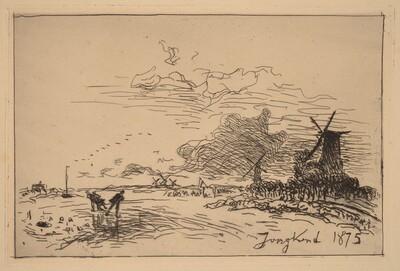
Holland Canal, near Rotterdam (Canal de Hollande, pres de Rotterdam (Hiver))
Jongkind, Johan Barthold
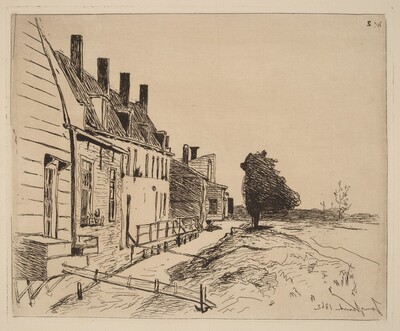
The Houses on the Canal Bank (Les Maisons au bord du canal)
Jongkind, Johan Barthold

The Nurse (La Nourrice)
Jongkind, Johan Barthold