
Provenance
Tchoukin, 1900. (Durand-Ruel, Paris and New York), 1922. Walther Halvorsen [1887-1972], 1922. (Svensk-Franska Konstgalleriet, Stockholm); sold by 1926 to Thorsten Laurin, Stockholm;[1] possibly (sale, Stockholm, 1939). Paul Mellon [1907-1999], Upperville, Virginia; bequest 1999 to NGA, with life interest to his wife, Rachel Lambert Mellon [1910-2014].
[1] Lent by Laurin to _Fransk Konst i Svensk privat Ägo_, Liljevalches Konsthall, Stockholm, January 1926, no. 202. Also listed in Ragnar Hoppe, _Katalog över Thorsten Laurins Samling_, Stockholm, 1936: 203, no. 434, pl. 237.
[2] Lent to _Degas' Racing World_, Wildenstein, New York, 1968: no. 91.
Accession Number
2014.18.62
Medium
oil on canvas
Dimensions
overall: 73.66 × 92.71 cm (29 × 36 1/2 in.) | framed: 83.82 × 102.24 × 7.62 cm (33 × 40 1/4 × 3 in.)
Classification
Painting
Credit Line
Collection of Mr. and Mrs. Paul Mellon
Tags
Painting Impressionist & Modern (1851–1900) Oil Painting Canvas French
Background & Context
Background Story
This painting of Longchamp racetrack shows Forain at his most Degas-like — but with a twist. The composition borrows Degas's high viewpoint and off-center cropping, but the focus is characteristically different. Where Degas gives us the dancers or the horses, Forain gives us the spectators: women in elaborate hats, men with binoculars, the social rituals that are the real reason for the racetrack's existence. The loose brushwork and dark palette reflect Forain's background in illustration and caricature, where speed and economy were professional necessities.
Cultural Impact
The Longchamp racetrack was one of the defining social spaces of Belle Epoque Paris — a place to see and be seen, where the demimonde mixed with the haut monde under the auspices of sport. Forain knew this world intimately and painted it with an insider's knowledge of its vanities and hypocrisies.
Why It Matters
Forain's race paintings are the flipside of Degas's: where Degas is Olympian, Forain is journalistic. Together they give us the complete picture of Paris at the races.
Related Artworks
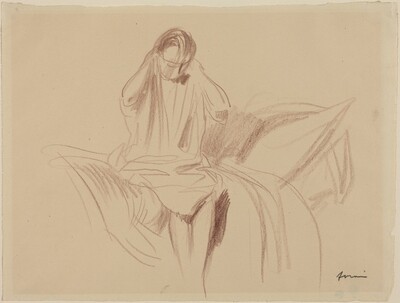
Morning
Forain, Jean-Louis
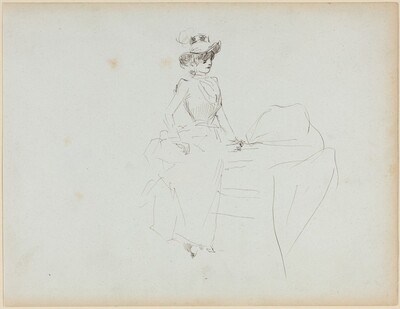
a) Woman with Bustle (recto); b) Sketch of a Woman's Face (verso)
Forain, Jean-Louis

a) Butler and Maid Resting (recto); b) Study of a Man Carrying a Package (verso)
Forain, Jean-Louis

a) Au village (In the Village) (recto); b) Au village (In the Village) (verso)
Forain, Jean-Louis