Provenance
The artist's brother-in-law, Léon Appert [d. 1925], Paris. private collection, Paris, by 1959.[1] Paul Mellon [1907-1999], Upperville, Virginia; bequest 1999 to NGA, with life interest to his wife, Rachel Lambert Mellon [1910-2014].
[1] Henri Dorra and John Rewald, _Seurat_, Paris, 1959: 86, no. 87.
Accession Number
2014.18.55
Medium
oil on wood
Dimensions
overall: 15.88 × 25.08 cm (6 1/4 × 9 7/8 in.)
Classification
Painting
Credit Line
Collection of Mr. and Mrs. Paul Mellon
Tags
Painting Impressionist & Modern (1851–1900) Oil Painting French
Background & Context
Background Story
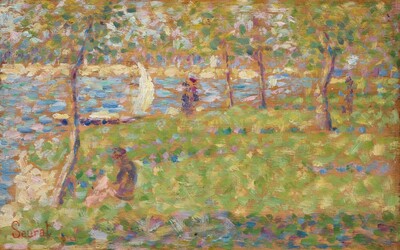
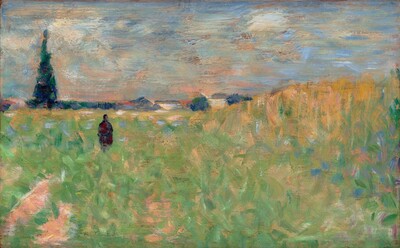
This small oil study on wood panel is one of the preparatory works for Seurat's landmark painting A Sunday on La Grande Jatte (1884-86) and its companion, Bathers at Asnieres. Seurat's method was to make numerous small studies en plein air before composing the final large canvas in the studio. This panel captures a horse and boats along the Seine with an economy and freshness that would be impossible in the finished work. The brushwork is still loose and Impressionist — not yet the Pointillist technique that Seurat would develop — but the careful attention to tonal relationships already points toward his revolutionary approach to color.
Cultural Impact
Seurat's preparatory studies are among the most beautiful works of the 19th century. Freed from the obligation to demonstrate a new technique, they show the artist thinking with his brush, working out color and composition problems in real time. The horse and boats motif would be refined and reorganized in the final painting, but this study preserves the direct encounter with nature that motivated the entire project.
Why It Matters
This panel reveals Seurat's Impressionist roots. Before he invented Pointillism, he was painting like Monet and Pissarro — and painting beautifully. The division of color into complementary tones was a discovery he made in these studies, not a theoretical imposition.