Provenance
Henry Valentine Stafford Jerningham, 9th Baron of Stafford [d. 1884]; (sale, Christie, Manson & Woods, London, 30 May 1885, no. 373, as _Blanche, daughter of Henry IV of England_). James Gurney; (sale, Christie, Manson & Woods, London, 12 March 1898, no. 7, as _Blanche, daughter of Henry IV of England_); Cooper.[1] M. de Villeroy, Paris; (sequestered property sale, Galérie Georges Petit, Paris, 28-29 April 1922, no. 34, as School of Vienna, _Portrait of a Lady_);[2] (Duveen Brothers, Inc., London and New York); sold 1923 to Clarence H. Mackay [1874-1938], Roslyn, New York; repurchased 1935 by (Duveen Brothers, Inc., London and New York); purchased 15 December 1936 by The A.W. Mellon Educational and Charitable Trust, Pittsburgh;[3] gift 1937 to NGA.
[1] The Getty Provenance Index lists a buyer named Cooper who purchased the work at the 1898 Christie's sale, according to the J. Paul Getty Museum's copy of the auction catalogue.
[2] According to the Getty Provenance Index, the Villeroy sale was held at Armand, Paris, rather than at Galérie Georges Petit. The Getty Museum's copy of the auction catalogue lists the buyer as Paul Jonas. However, Duveen Brothers was in possession of the work within the year of the Villeroy sale (perhaps Jonas was an agent for Duveen).
[3] The original Duveen Brothers invoice is in Gallery Archives, copy in NGA curatorial files.
Accession Number
1937.1.23
Medium
oil on panel
Dimensions
painted surface: 52 × 36.6 cm (20 1/2 × 14 7/16 in.) | overall (panel): 53 × 37.6 cm (20 7/8 × 14 13/16 in.) | framed: 74.3 × 61.28 × 7.62 cm (29 3/8 × 24 1/4 × 3 in.)
Classification
Painting
Credit Line
Andrew W. Mellon Collection
Tags
Painting Renaissance (1400–1599) Oil Painting Panel Painting
Background & Context
Background Story
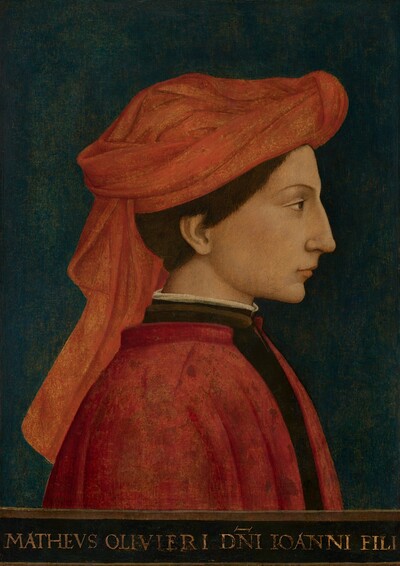
Profile Portrait of a Lady from c. 1410 is an anonymous portrait in the Franco-Flemish style of the early 15th century, depicting a woman in strict profile in the manner that was common in Northern Renaissance portraiture of the period. The profile format derives from the convention of antique cameos and medals that was adopted by Northern Renaissance portrait painters, and the strict profile pose emphasizes the sitter's features and headdress rather than creating the illusion of three-dimensional presence that the three-quarter profile would later introduce. The c. 1410 date makes this one of the earliest portraits in the Northern Renaissance tradition.
Cultural Impact
Profile Portrait of a Lady is important in the history of Northern Renaissance portraiture because it demonstrates the strict profile format that was the earliest convention of Northern portrait painting. The c. 1410 date makes this one of the earliest portraits in the Northern Renaissance tradition, and the strict profile pose—derived from antique cameos and medals—shows the convention from which Northern portraiture would develop before the three-quarter profile was introduced later in the 15th century.
Why It Matters
Profile Portrait of a Lady is one of the earliest Northern Renaissance portraits: a woman in strict profile deriving from the cameo and medal convention that was the starting point of Northern portraiture. The c. 1410 painting shows the profile format from which Northern portrait painting would develop before the three-quarter profile replaced it.

![Saint Bernard and Saint Catherine of Alexandria with the Virgin of the Annunciation [right panel]](https://api.nga.gov/iiif/e6890364-4d99-4684-a62b-5060ee3c3446/full/400,/0/default.jpg)