Provenance
Commissioned by the sitter's husband, Francis Basset,[1] and probably remained in his family, descending through the owners of Tehidy, the family estate near Camborne, Cornwall, to A.F. Basset; sold 1907 to (Asher Wertheimer, London). (Thos. Agnew and Sons, London), in 1908.[2] Sir George Donaldson [1845-1925], London; sold to William Andrews Clark [1839-1925], New York, by 1916;[3] bequest 1926 to the Corcoran Gallery of Art, Washington; acquired 2014 by the National Gallery of Art.
[1] When Francis Basset had portraits of himself (NGA 2014.79.705) and his wife painted around 1786, he was 1st baron Basset of Stratton. He was created 1st baron de Dunstanville a decade later, in 1796.
[2] The date of the Basset sale to Wertheimer and the date when the painting was with Agnew's are from Ellis Waterhouse, "Preliminary Check List of Portraits by Thomas Gainsborough," _Walpole Society_ 33 [1948-1950] (1953): 33, and Ellis Waterhouse, _Gainsborough_, London, 1958: 64, no. 219. The "A.F. Basset" name given by Waterhouse is most likely Arthur Francis Basset (1873-1950), the fourth owner of Tehidy after the sitter, who sold the estate in 1915. The entry for the painting in Dana H. Carroll, _Catalogue of Objects of Fine Art and Other Properties at the Home of William Andrews Clark, 962 Fifth Avenue_, Part I, unpublished manuscript, n.d. (1925): 141, no. 91, lists M. Knoedler and Co., Inc., New York, but not Basset or Agnew's.
[3] Letter, 27 March 1916, Clark to C. Powell Minnigerode of the Corcoran Gallery of Art, in which he mentions the two Gainsboroughs that Minnigerode "saw in my gallery"; copy in NGA curatorial files.
Accession Number
2014.79.706
Medium
oil on canvas
Dimensions
overall: 127.2 × 101 cm (50 1/16 × 39 3/4 in.) | framed: 151.1 × 127 × 8.3 cm (59 1/2 × 50 × 3 1/4 in.)
Classification
Painting
Credit Line
Corcoran Collection (William A. Clark Collection)
Tags
Painting Neoclassical & Romantic (1751–1850) Oil Painting Canvas British Color: Orange Color: White
Background & Context
Background Story
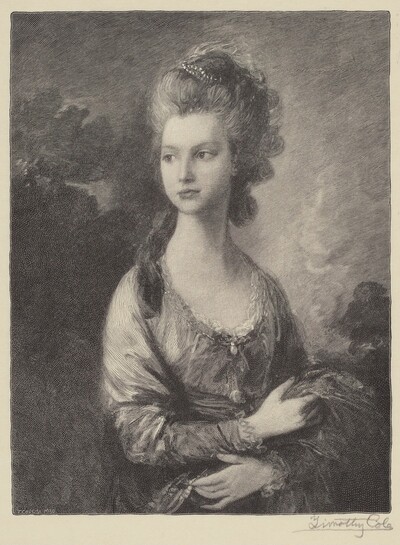
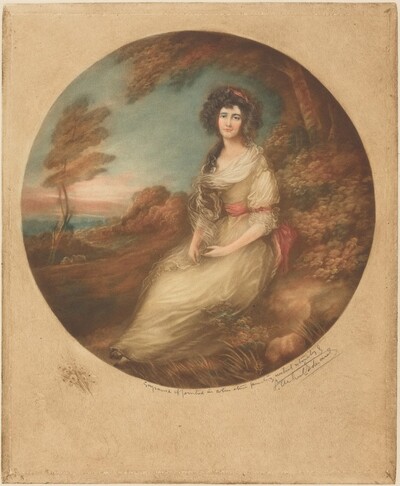
Lady de Dunstanville, née Frances Susanna Fitzpatrick, sits for Gainsborough in the full bloom of middle age, her expression alert and intelligent beneath a magnificent hat. This portrait from Gainsborough's late period shows his ability to combine psychological penetration with the decorative surface that his patrons demanded. The paint handling is exceptionally free — the lace, the feathers, the ribbon are conjured from a few brilliant strokes that suggest rather than describe. Lady de Dunstanville was one of the wealthy society women who sustained Gainsborough's practice, and his affection for her is evident in the generosity of the painting.
Cultural Impact
Gainsborough's late portraits achieve a synthesis that had eluded him in earlier decades. The English portrait tradition required a likeness and a display of status; Gainsborough's personal obsession was landscape and natural beauty. In his best portraits, the sitter becomes a landscape — the folds of silk become contours, the face catches light like a meadow, and the whole composition breathes with the freedom of his beloved Suffolk countryside.
Why It Matters
This portrait shows why Gainsborough was preferred to Reynolds by many of his sitters. He gave them not just a likeness but an atmosphere — a world of sensuous beauty in which they could believe they truly belonged.