Provenance
Probably H. Verschuring, The Hague, by 1751. Gottfried Winkler [1731-1795], Leipzig, by 1765.[1] Possibly with (Stéphane Bourgeois [Bourgeois Frères], Paris), in 1893/1894.[2] Rodolphe Kann [1845-1905], Paris, by 1898;[3] purchased 1907 with the entire Kann collection by (Duveen Brothers, Inc., London, New York, and Paris);[4] sold to (F. Kleinberger & Co., Paris);[5] by exchange to (Leo Nardus [1868-1955], Suresnes, France, and New York); by exchange early 1909 to Peter A.B. Widener, Lynnewood Hall, Elkins Park, Pennsylvania;[6] inheritance from Estate of Peter A.B. Widener by gift through power of appointment of Joseph E. Widener, Elkins Park; gift 1942 to NGA.
[1] Gerard Hoet, _Catalogus of Naamlyst van Schilderijen..._, 2 vols., The Hague, 1752, 2: 482, lists in the collection of H. Verschuring "Een Oud Vrouwtje door Rembrandt. h.9d., br. 8d." The next painting listed was a pendant of an old man. Both paintings were then catalogued in the Winkler collection in 1768: Franz Wilhelm Kreuchauf, _Historische Erklaerungen der Gemaelde welche Herr Gottfried Winkler in Leipzig gesammelt_, Leipzig, 1798: nos. 495 and 496. Three years earlier, in 1765, the painting had been engraved in reverse by J.H. Bause, who for some reason dedicated his print to Johann Jacob Haid of Augsburg. Bause also engraved the pendant (no. 496 from Winkler's catalogue); the description of the latter work is: "Der Kopf eines betagten Mannes, mit dickaufgeschwollener Nase, kurzem Haare und Barte." This painting has disappeared but is listed in Cornelis Hofstede de Groot, _A Catalogue Raisonné of the Works of the Most Eminent Dutch Painters of the Seventeenth Century..._, trans. Edward G. Hawke, 8 vols., London, 1907-1927: 6(1916):no. 461. A photograph of Bause's engraving of the old man is in the NGA curatorial files.
[2] Émile Michel, _Rembrandt: His Life, His Work, and His Time_, Trans. Florence Simmonds, 2 vols., New York, 1894: 2:238, gives the following description of a painting in the possession of "M. Steph. Bourgeois": "Bust Portrait of a Woman, three-quarter to the front, small size. About 1640. W[ood]. 7 7/8 x 6 1/2 inches." It is possible that this painting is in fact _Head of an Aged Woman_, and that Rodolphe Kann obtained it from Bourgeois, but so far no direct evidence has come to light that supports this theory. Bourgeois was the father-in-law of Leo Nardus, the dealer from whom Peter A.B. Widener received the painting in 1909.
[3] Kann lent the painting to an exhibition in Amsterdam in 1898.
[4] Duveen Brothers Records, accession number 960015, Research Library, Getty Research Institute, Los Angeles: reels 38 and 39, boxes 115-118, Stock books, Paris Ledger, and Sales Book for the Kann Collection.
[5] Duveen Brothers Records, accession number 960015, Research Library, Getty Research Institute, Los Angeles: reel 39, box 117, Paris Ledger, no. 1, Kann Collection.
[6] Nardus received this painting and NGA’s _Head of Saint Matthew_ (1942.9.58) from Kleinberger in exchange for a portrait of a lady by Hans Memling. The same two paintings, along with ten others, were sent to Widener in early 1909, as replacements for a dozen paintings Nardus had sold to and then took back from the collector, after they were deemed by art historians of the day to be modern copies of “Old Masters.”
These two transactions involving Nardus are revealed in correspondence between Widener, his lawyer, John G. Johnson, Nardus, and Nardus’ assistant, Michel van Gelder, now in the John G. Johnson Collection Archives at the Philadelphia Museum of Art (box 5, folders 5 and 6, especially a letter, Michel van Gelder to John G. Johnson, 29 January 1909). The correspondence was found, transcribed, and kindly shared with the NGA by Jonathan Lopez (letter, sent with transcriptions, 24 April 2006, to Arthur K. Wheelock, Jr., in NGA curatorial files). See also Jonathan Lopez, “‘Gross False Pretenses’: The Misdeeds of Art Dealer Leo Nardus,”_ Apollo_, ser. 2, vol. 166, no. 548 (December 2007): 80–81, fig. 9.
Accession Number
1942.9.64
Medium
oil on panel
Dimensions
overall: 21.1 x 17.5 cm (8 5/16 x 6 7/8 in.)
Classification
Painting
Credit Line
Widener Collection
Tags
Painting Baroque (1600–1750) Oil Painting Panel Painting Dutch
Background & Context
Background Story
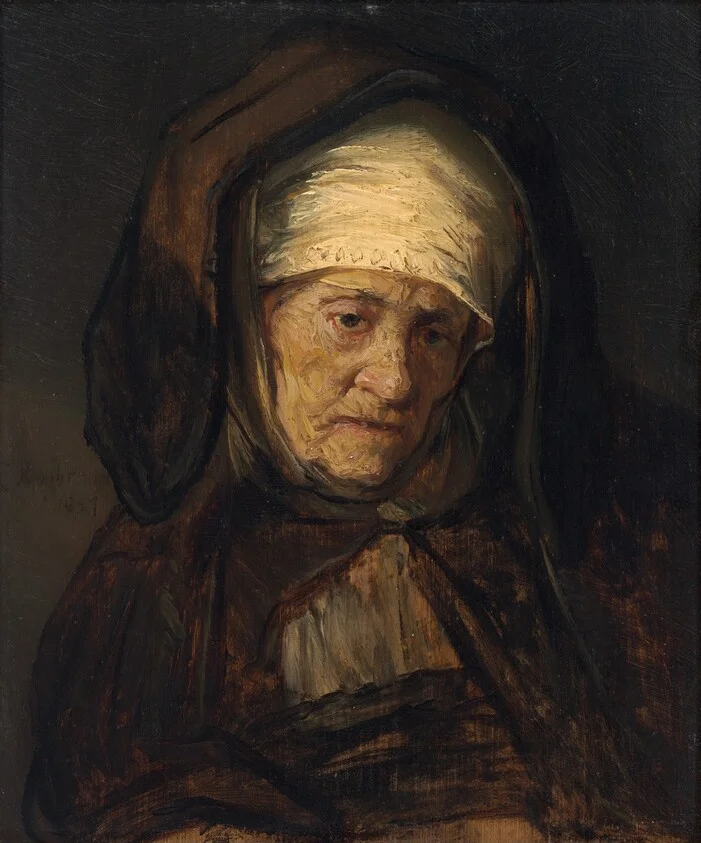
Head of an Aged Woman (c. 1630-1640) is one of Rembrandt's most penetrating studies of age—the physical and spiritual condition that his art consistently honored with an attention that other painters reserved for youth and beauty. The aged woman, with her lined face, her thinning hair, and the particular quality of elderly skin that Rembrandt rendered with unmatched subtlety, embodies the wisdom, experience, and vulnerability that age produces. The 1630-40 date places this during the period when Rembrandt was developing the figure study method that would produce some of his most celebrated works. His treatment of the aged woman's head demonstrates his ability to find beauty in the features that conventional portraiture typically avoided: the lines that recorded decades of expression, the skin that had lost its youthful elasticity, and the eyes that had seen more than the young could imagine. Rembrandt's chiaroscuro—the dramatic contrast between illuminated features and surrounding shadow—gives the aged face a visual authority that more conventional beauty could not achieve: the light that models the features reveals the life that the face records, and the shadow that surrounds the head gives it a spiritual presence that transcends physical appearance. The study also belongs to Rembrandt's practice of using anonymous models—old women, street vendors, and other ordinary people whose faces carried the experience that his art sought to record.
Cultural Impact
Rembrandt's aged figure studies influenced how age was represented in Western art, replacing the convention of idealized beauty with the psychological depth that age's physical signs revealed. The paintings influenced later portraitists who similarly found significance in aged faces, from the Dutch genre painters to Lucian Freud. Head of an Aged Woman influenced how the relationship between physical appearance and inner experience was understood, arguing that age reveals what youth conceals.
Why It Matters
This painting matters because it demonstrates Rembrandt's most distinctive contribution to Western art—the ability to find beauty and significance in the physical signs of age that conventional painting avoided. The aged woman's lined face becomes a record of lived experience, and Rembrandt's chiaroscuro reveals the inner life that the features express, arguing that age is not a diminishment but a revelation.