
Provenance
Commissioned 1936 for the Hall of Negro Life, Texas Centennial Exposition, Dallas;[1] possibly Wiley College, Marshall, Texas.[2] Joseph Mack [1920-1986]; sold to Thurlow Evans Tibbs, Jr. [1952-1997], Washington, by 1987;[3] by gift and partial purchase 1996 to the Corcoran Gallery of Art, Washington; acquired 2014 by the National Gallery of Art.
[1] A letter from Jesse O. Thomas and Alonzo J. Aden (General Manager and Curator of Exhibitions, respectively, of the Hall of Negro Life) to Aaron Douglas, dated 5 July 1936, hints that the Harmon Foundation gave financial support for the commission; copy in NGA curatorial files, and the Evans-Tibbs Collection, Vertical Files, NGA Library.
[2] According to Hilda Stewart Proctor, “The Aaron Douglasses Celebrate 25th Year,” clipping from an unidentified newspaper, about 18 August 1951; copy in NGA curatorial files, and the Evans-Tibbs Collection, Vertical Files, NGA Library.
[3] In a Condition and Treatment Report for the painting, prepared by Quentin Rankin (3 April 1987, Corcoran conservation records, in NGA Painting Conservation Department), Thurlow Evans Tibbs Jr. is specified as the owner.
Accession Number
2014.79.17
Medium
oil on canvas
Dimensions
overall: 153.4 × 153.7 cm (60 3/8 × 60 1/2 in.) | framed: 165.1 × 164.47 × 8.26 cm (65 × 64 3/4 × 3 1/4 in.)
Classification
Painting
Credit Line
Corcoran Collection (Museum Purchase and partial gift from Thurlow Evans Tibbs, Jr., The Evans-Tibbs Collection)
Tags
Painting Early Modern (1901–1950) Oil Painting Canvas American
Background & Context
Background Story
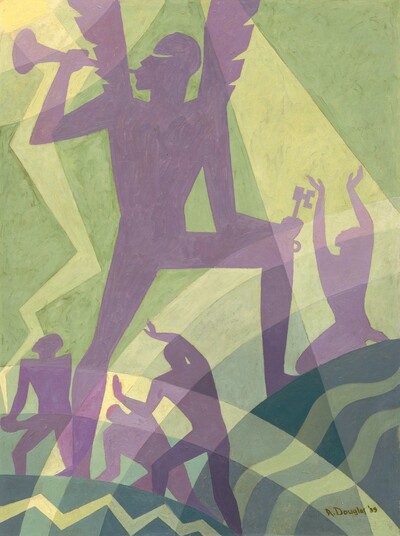
Aaron Douglas's "Into Bondage" is one of four murals commissioned by the Texas Centennial Exposition in 1936, created during the height of the Harlem Renaissance. The painting depicts enslaved Africans being led toward ships, their figures rendered in Douglas's signature silhouetted style — angular, geometric forms that merge Art Deco aesthetics with African visual traditions. Chains snake through the composition while a lone figure raises a hand toward a single star of hope, creating a powerful visual metaphor for the forced Middle Passage.
Douglas was the leading visual artist of the Harlem Renaissance, often called the movement's "father of African American art." Born in Topeka, Kansas, in 1898, he moved to Harlem in 1925 and quickly became the most sought-after illustrator of the era, creating iconic images for James Weldon Johnson's "God's Trombones," Alain Locke's "The New Negro," and countless Covers for The Crisis and Opportunity magazines. His flat, silhouette-based style drew from African sculpture, Egyptian reliefs, and modernist design principles, synthesizing these influences into a distinctly African American visual language.
"Into Bondage" and its companion piece "Aspiration" were originally exhibited as murals at the Hall of Negro Life at the Texas Centennial in Dallas. The four panels chronicled the African American journey from slavery through emancipation to modern achievement. Together, they constituted one of the first major public commissions for an African American artist in the United States. The silhouetted figures, painted in graduated tones of violet and green against concentric circles of light, draw on Douglas's mastery of what he called "Afro-centric" design — a visual vocabulary that refused Western perspectival conventions in favor of a flattened, symbolic space more akin to Egyptian and West African traditions. The star that one figure reaches toward is not merely decorative; it represents the North Star, a literal and symbolic guide for enslaved people seeking freedom.
Cultural Impact
Douglas's murals fundamentally changed how African Americans were represented in fine art. Before Douglas, depictions of Black life in American painting were overwhelmingly stereotypical or invisible. Douglas insisted on depicting Black subjects with dignity, heroism, and historical agency — not as victims but as participants in a grand narrative of struggle and triumph. His work established a visual vocabulary for Black pride that would echo through the Civil Rights era and beyond.
Why It Matters
"Into Bondage" represents a landmark in American art — one of the first times an African American artist was given a major public platform to represent the full pain and aspiration of the Black experience. Douglas's fusion of modernist aesthetics with African visual traditions created a template for African American art that remains influential today.
![Saint Bernard and Saint Catherine of Alexandria with the Virgin of the Annunciation [right panel]](https://api.nga.gov/iiif/e6890364-4d99-4684-a62b-5060ee3c3446/full/400,/0/default.jpg)