Provenance
(Boussod et Valadon, Paris); William A. Clark [1839-1925], New York; bequest April 1926 to the Corcoran Gallery of Art, Washington; acquired 2015 by the National Gallery of Art.
Accession Number
2015.19.24
Medium
oil on canvas
Dimensions
overall: 40.64 × 55.88 cm (16 × 22 in.) | framed: 59.37 × 74.3 × 7.62 cm (23 3/8 × 29 1/4 × 3 in.)
Classification
Painting
Credit Line
Corcoran Collection (William A. Clark Collection)
Tags
Painting Impressionist & Modern (1851–1900) Oil Painting Canvas French
Background & Context
Background Story
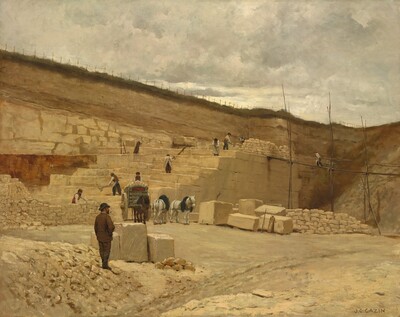
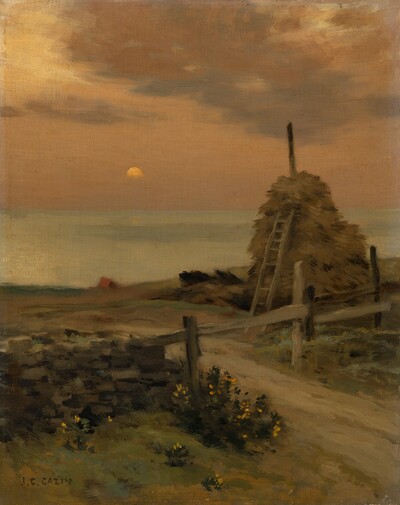
Cazin's landscapes of the 1870s and 1880s established his reputation as one of the leading figures of the French naturalist movement. This undated landscape, painted after 1876, shows his characteristic method: a low horizon, a vast sky filled with subtly modulated clouds, and a flat terrain that stretches toward the distance with the kind of atmospheric perspective that Millet and Corot had pioneered. The tonal harmony — silvers, greens, and earth browns — creates a mood of contemplative stillness that is Cazin's signature.
Cultural Impact
Cazin occupied a middle position between the Barbizon naturalists and the Impressionists. He shared the Barbizon commitment to observed reality and the Impressionist interest in atmospheric effect, but he rejected both the Barbizon tendency toward picturesque sentimentality and the Impressionist abandonment of tonal unity. His landscapes are distinguished by a muted, almost monochromatic palette that suggests the specific light of northern France.
Why It Matters
Landscape is Cazin's philosophy made visible: the beauty of the French countryside lies not in dramatic effects but in the subtle modulation of tone and atmosphere. The painting asks the viewer to slow down and see what is actually there, not what they expect to see.