Provenance
The artist [1898-1954]; by inheritance 1954 to the artist's second wife and widow, Felicia Meyer Marsh [1912-1978]; gift 1958 to the Corcoran Gallery of Art, Washington; acquired 2014 by the National Gallery of Art.
Accession Number
2014.136.78
Medium
egg tempera on hardboard
Dimensions
overall: 90.81 × 75.41 cm (35 3/4 × 29 11/16 in.) | framed: 113.03 × 97.79 × 6.99 cm (44 1/2 × 38 1/2 × 2 3/4 in.)
Classification
Painting
Credit Line
Corcoran Collection (Gift of Felicia Meyer Marsh)
Tags
Painting Early Modern (1901–1950) Tempera Board American Color: Gold
Background & Context
Background Story
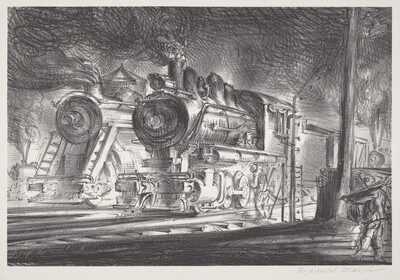
Reginald Marsh (1898-1954) was an American painter known for his densely populated scenes of New York City life—burlesque shows, Coney Island, subways, and waterfronts—rendered with the nervous line and egg tempera technique that distinguish his work from the smoother manner of American Scene painting. Smokehounds from 1934 depicts a scene of men smoking in the egg tempera medium that Marsh adopted from the early Renaissance painters, using it to create the nervous, hatched line that distinguishes his figure drawing from the smoother modeling of his contemporaries. The 1934 date places this in Marsh's most productive period, when he was producing the New York genre scenes that are his most accomplished works.
Cultural Impact
Smokehounds is important in Marsh's oeuvre because it demonstrates the egg tempera technique and nervous line that distinguish his work from the smoother manner of American Scene painting. Marsh's adoption of egg tempera—an early Renaissance medium—gave his figure drawing the nervous, hatched line that makes his densely populated New York scenes both more energetic and more specific than the smoother figure painting of his Regionalist contemporaries.
Why It Matters
Smokehounds is Marsh's nervous line in egg tempera: a scene of men smoking rendered in the early Renaissance medium that gives his figure drawing the nervous, hatched line that distinguishes his work from the smoother manner of American Scene painting. The 1934 painting shows Marsh's New York genre scenes at their most energetically drawn.