Provenance
(Durand-Ruel, Paris).[1] Adolph Edward Borie [1809-1880], Philadelphia;[2] Harry Samuel Henry, Philadelphia; (his sale, American Art Association, New York, 25 January 1907, no. 3, as _The River_); William A. Clark [1839-1925], New York; bequest April 1926 to the Corcoran Gallery of Art, Washington; acquired 2015 by the National Gallery of Art.
[1] The dealer's stencil is on the reverse of the painting.
[2] Borie's name is given in the 1907 Henry sale catalogue.
Accession Number
2015.143.9
Medium
oil on canvas
Dimensions
overall: 41.91 × 57.15 cm (16 1/2 × 22 1/2 in.) | framed: 57.15 × 72.39 × 5.4 cm (22 1/2 × 28 1/2 × 2 1/8 in.)
Classification
Painting
Credit Line
Corcoran Collection (William A. Clark Collection)
Tags
Painting Impressionist & Modern (1851–1900) Oil Painting Canvas French Color: Yellow Color: Gray
Background & Context
Background Story
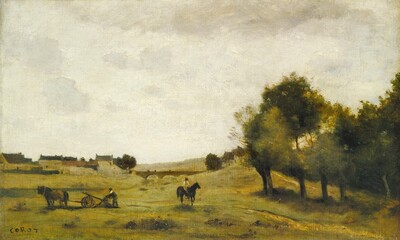
Landscape (c. 1870/1875) represents Corot's mature style at the height of its poetic power—the silvery tonalities, the softly suggested foliage, and the atmospheric depth that made Corot the most influential landscape painter of the mid-19th century. The 1870-75 date places this during Corot's final period, when his landscape method had achieved the synthesis of observation and memory that distinguished his best work. By this date, Corot was no longer making the direct transcriptions of outdoor experience that had characterized his early work; instead, he was composing landscapes in the studio from memory and imagination, producing works that were less topographically specific but more atmospherically resonant. This mature Corot landscape typically features the elements that younger painters found so influential: the silver-gray tonal unity, the clusters of trees with their characteristic leaf-cluster technique (building foliage from small, individually brushed masses rather than from linear description), and the small figures that animate the scene without dominating it. The painting's date also connects it to the historical context of the Franco-Prussian War (1870-71) and the Paris Commune (1871)—events that disrupted French life but that Corot's poetic landscapes seem to transcend, offering visions of harmony that the contemporary reality could not provide.
Cultural Impact
Corot's mature landscapes influenced virtually every landscape painter of the late 19th century, from the Impressionists to the Symbolists. The silvery tonal unity influenced how atmosphere was represented in painting, establishing a chromatic approach that Monet, Pissarro, and Sisley would adapt to their own purposes. The memory-based landscape method influenced how landscape painting was practiced, establishing the tradition of composing in the studio from remembered experience.
Why It Matters
This painting matters because it represents the Corot style that influenced an entire generation of painters—the poetic landscape of silvery tonalities and suggested forms that became the standard against which late 19th-century landscape painting was measured. Without Corot's example, the Impressionist landscape would have developed in a very different direction.