Provenance
Probably owned by Francis Nathaniel, 2nd marquess Conyngham [1797-1876], Mount Charles, County Donegal, and Minster Abbey, Kent.[1] Sir Hugh Hume-Campbell, 7th bart. [1812-1894], Marchmont House, Borders, Scotland, by 1857;[2] (his estate sale, Christie, Manson, & Woods, London, 16 June 1894, no. 48); (P. & D. Colnaghi & Co., London); sold 1894 to Peter A.B. Widener, Lynnewood Hall, Elkins Park, Pennsylvania; inheritance from Estate of Peter A.B. Widener by gift through power of appointment of Joseph E. Widener, Elkins Park, Pennsylvania; gift 1942 to NGA.
[1] The only source of information concerning the picture's whereabouts prior to 1857 is Hofstede de Groot, whose listing of the painting is extremely confusing (Cornelis Hofstede de Groot, _A Catalogue Raisonné of the Works of the Most Eminent Dutch Painters of the Seventeenth Century_, trans. Edward G. Hawke, 8 vols., London, 1907-1927: 4(1912):92, no. 285, possibly also 119, no. 367, 134, no. 418, 203, no. 643c). It seems that any or all of his four entries (nos. 285, 367, 418, and 643c) may contain information that relates to the _Forest Scene_, but these entries also contain additional and contradictory provenance listings, which must refer to at least one other painting. It nonetheless seems likely that before the _Forest Scene_ was acquired by Sir Hugh Hume Campbell, it was indeed owned by a member of the Conyngham family of Ireland, most probably the 2nd marquess, but also possibly his father, Henry, 3rd baron and 1st marquess Conyngham (1766-1832).
[2] Gustav Friedrich Waagen, _Treasures of Art in Great Britain: Being an Account of the Chief Collections of Paintings, Drawings, Sculptures and Illuminated Mss., 3 vols., London, 1854-1857, supplement: 441-442.
Accession Number
1942.9.80
Medium
oil on canvas
Dimensions
overall: 105.5 x 123.4 cm (41 9/16 x 48 9/16 in.)
Classification
Painting
Credit Line
Widener Collection
Tags
Painting Baroque (1600–1750) Oil Painting Canvas Dutch
Background & Context
Background Story
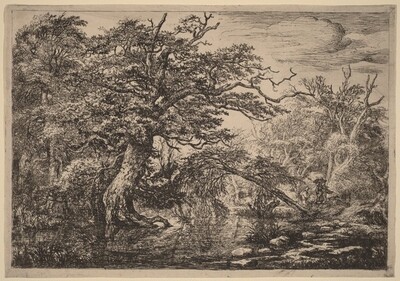
Forest Scene (c. 1655) represents Jacob van Ruisdael's mastery of the Dutch forest landscape—the subject that made him the most important landscape painter of the Dutch Golden Age. The 1655 date places this during Ruisdael's early maturity, when he was developing the approach to forest subjects that would influence landscape painting for centuries. The Dutch Republic in the 1650s was experiencing unprecedented prosperity, and the landscape painting that flourished during this period reflected the nation's pride in its terrain, its water management, and the specific quality of Dutch light that painters found so compelling. Ruisdael's forest scenes differ from his predecessors' in their dramatic power: where earlier Dutch landscape painters had emphasized the peaceful, cultivated quality of the Dutch countryside, Ruisdael found the forest's wild, untamed character—the massive trees, the broken branches, and the deep shadows that gave his landscapes an emotional intensity unprecedented in Dutch painting. His treatment of the forest's interior—the complicated play of light filtering through canopy, the texture of bark, and the specific atmosphere of the forest floor—demonstrates an observational precision that distinguishes his work from the more generalized landscape treatments common in the period. The painting also reflects the 17th-century Dutch understanding of nature as a revelation of divine power—the forest's grandeur suggests a creation that exceeds human comprehension, an attitude that gave Dutch landscape painting its characteristic combination of observational precision and spiritual depth.
Cultural Impact
Ruisdael's forest paintings influenced the entire tradition of European landscape art, establishing the forest interior as a significant subject that painters from the Barbizon school to the Hudson River School would adopt. The paintings influenced how forests were culturally understood in Northern Europe, connecting natural scenery to religious and national identity. The dramatic treatment influenced later Romantic landscape painters, from Friedrich to the American Sublime tradition.
Why It Matters
This painting matters because it represents the origin of the dramatic forest landscape tradition that would influence European and American painting for three centuries—the combination of observational precision and emotional intensity that made Ruisdael the most significant landscape painter of the Dutch Golden Age and the most important precursor of the Romantic landscape tradition.