Provenance
(Eugene Glaenzer, Paris); purchased 1914 by (M. Knoedler & Co., London); sold 1924 to R. Horace Gallatin [1871-1948], New York;[1] gift 1949 to NGA.
[1] Glaenzer was a dealer active in Paris and New York during the early 1900s. All the provenance information is from the Knoedler records, provided by Martha Hepworth of the Getty Provenance Index (letter of 25 February 1992, NGA curatorial files).
Accession Number
1949.1.6
Medium
oil on wood
Dimensions
overall: 19.1 x 30.3 cm (7 1/2 x 11 15/16 in.) | framed: 34.6 x 45.7 x 6 cm (13 5/8 x 18 x 2 3/8 in.)
Classification
Painting
Credit Line
Gift of R. Horace Gallatin
Tags
Painting Neoclassical & Romantic (1751–1850) Oil Painting Italian
Background & Context
Background Story
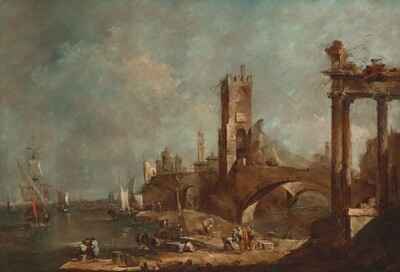
Rialto Bridge, Venice from c. 1770-1800 is a painting by a follower of Francesco Guardi, depicting Venice's most famous bridge in the vedute (view painting) tradition that was Venice's most important contribution to 18th-century painting. The painting follows Guardi's approach to Venetian view painting—spontaneous, atmospheric, and less precisely detailed than Canaletto's—but is executed by a follower rather than the master himself. The Rialto Bridge and the Grand Canal are rendered with the characteristic Guardi emphasis on atmosphere and light rather than architectural precision, and the oil on wood support creates a luminosity that enhances the atmospheric effect.
Cultural Impact
Paintings by followers of Guardi are important documents of the Venetian vedute tradition because they demonstrate how widely Guardi's atmospheric approach to view painting was appreciated and imitated in the late 18th century. The Rialto Bridge by a follower of Guardi shows that Guardi's influence extended beyond his own workshop to a broader circle of painters who adopted his characteristic emphasis on atmosphere and light over architectural precision.
Why It Matters
Rialto Bridge by a follower of Guardi shows the reach of the master's atmospheric approach to Venetian view painting: the Grand Canal and its most famous bridge rendered with Guardi's emphasis on atmosphere and light rather than Canaletto's architectural precision. The c. 1770/1800 painting demonstrates how widely Guardi's vedute style was imitated in late 18th-century Venice.