Provenance
Carlile Pollock [1749-1806], New Orleans and New York, the sitter's brother; by descent, through his daughter and grandson, to his grandniece, Mrs. Emma G. Terry Lull;[1] sold by 1896 to George H. Story, New York; by whom sold to (Ehrich Bros., New York); from whom purchased 1913 by Jesse A. Wasserman, New York. (Ehrich Bros., New York); sold to (Doll and Richards); from whom it was purchased 1916 by Mrs. David P. Kimball, Boston; sold 17 December 1918 to Thomas B. Clarke [1848-1931], New York;[2] sold by Clarke's executors 29 January 1936 through (M. Knoedler & Co., New York), as part of the Clarke collection, to The A.W. Mellon Educational and Charitable Trust, Pittsburgh; gift 1942 to NGA.
[1] A page of typed provenance notes of unknown authorship in the NGA curatorial file states that Emma Lull [1836-1919] owned the portrait from "1882-97, at least," and gives her location as Boston and Sharon, Connecticut. A second page of notes in the same file lists her address as Annapolis, Maryland.
[2] Clarke acquisition date is according to 1928 Clarke exhibition catalogue annotated with information from files of M. Knoedler & Co., NY (copy in NGA curatorial records and in NGA library).
Accession Number
1942.8.15
Medium
oil on canvas
Dimensions
overall: 77 x 64 cm (30 5/16 x 25 3/16 in.) | framed: 94 x 81.3 x 6.2 cm (37 x 32 x 2 7/16 in.)
Classification
Painting
Credit Line
Andrew W. Mellon Collection
Tags
Painting Neoclassical & Romantic (1751–1850) Oil Painting Canvas Swedish
Background & Context
Background Story
Carl Fredrik von Breda (1759-1818) was a Swedish painter who studied with Joshua Reynolds in London and became known for his portraits in the Grand Manner that Reynolds had established as the standard for British portraiture. Mrs. William Hartigan from 1787-96 depicts the sitter in the Grand Manner that Breda learned from Reynolds—the full-length pose, the classical attitude, and the rich color that define the British Grand Manner portrait. The 1787-96 date places this in Breda's London period, when he was producing portraits of British society figures in the Reynolds manner that he had absorbed as Reynolds's pupil.
Cultural Impact
Mrs. William Hartigan is important in the history of Swedish and British portraiture because it demonstrates the international reach of the Reynolds Grand Manner. Breda was one of several Swedish painters who studied with Reynolds and brought the British Grand Manner back to Scandinavia, and his portraits show the Reynolds manner adapted to Swedish taste—a combination of British grandeur and Scandinavian restraint.
Why It Matters
Mrs. William Hartigan is the Reynolds Grand Manner via Sweden: a British society portrait painted by a Swedish pupil of Reynolds in the Grand Manner pose, classical attitude, and rich color that define British portraiture at its most ambitious. The 1787-96 portrait demonstrates the international reach of the Reynolds manner beyond Britain.

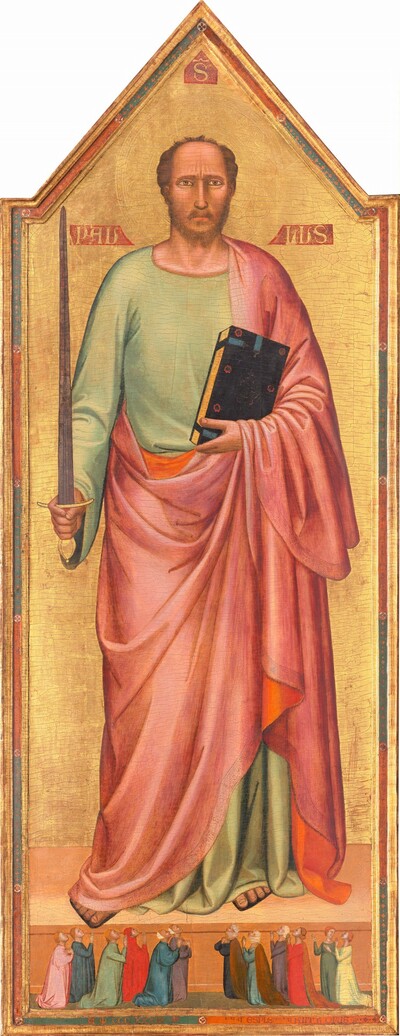
![Saint Bernard and Saint Catherine of Alexandria with the Virgin of the Annunciation [right panel]](https://api.nga.gov/iiif/e6890364-4d99-4684-a62b-5060ee3c3446/full/400,/0/default.jpg)