Provenance
Probably Anna Theresia van Halen; (her sale, Antwerp, 19 August 1749, no. 1); Gaillard de Gagny (receiver of finances), Grenoble;[1] (his estate sale, Pierre Remy, Paris, 29 March 1762, no. 9); purchased by Jean-Henri Eberts for Markgräfin Karoline Luise von Baden [1723-1783];[2] (her sale, Amsterdam, 6 March 1769, no. 3); Etienne-François, duc de Choiseul [1719-1785], Paris and Château de Canteloup, Touraine; (his sale, at his residence, Paris, 6-10 April 1772, no. 1); purchased through (Augustin Ménageot, Paris) by Prince Alexander M. Golitzyn for Catherine II, empress of Russia [1729-1796], for the Imperial Hermitage Gallery, Saint Petersburg;[3] purchased March 1930, as a painting by Peter Paul Rubens, through (Matthiesen Gallery, Berlin; P. & D. Colnaghi & Co., London; and M. Knoedler & Co., New York) by Andrew W. Mellon, Pittsburgh and Washington, D.C.; deeded 30 March 1932 to The A.W. Mellon Educational and Charitable Trust, Pittsburgh;[4] gift 1937 to NGA.
[1] The sale of the collection of Anna Theresia van Halen is described by Gerard Hoet, _Catalogues of naamlyst van schilderyen, met derzelver pryzen, zedert een langen reeks van jaaren zoo in Holland als op andere plaatzen in het openbaar verkogt, benevens een verzameling van listen van verscheyden nog in wezen zynde cabinetten_, 3 vols., The Hague, 1752-1770: 2:256. The provenance back to the Gaillard de Gagny sale is described by Jan Lauts, "Einiges über Markgräfin Karoline Luise von Baden als Gemäldesammlerin," _Jahrbuch der Staatlichen Kunstsammlungen in Baden-Württemberg_ 15 (1978): 49, 53-56.
[2] The correspondence between Eberts and the Markgräfin has been digitized; see the website _Karoline Luise von Baden. Kunst und Korrespondenz_, http://www.karoline-luise.la-bw.de/, launched in late 2016.
[3] Eberts in 1762 purchased the painting for 2,050 livres, while Ménageot in 1772 bought it for 7,380 livres. Dr. Nicole Willk-Brocard, in a letter of 19 January 1997, kindly provided information about Ménageot and his role in the sale (in NGA curatorial files); see also her article, "Augustin Ménageot (ca. 1700-1784), Marchand de Tableaux, Quelques Jalons," _Gazette des Beaux-Arts_ (April 1998): 161-182.
[4] Mellon purchase date and date deeded to Trust according to Mellon collection files in NGA curatorial records and David Finley's notebook (donated to the National Gallery of Art in 1977 and now in Gallery Archives).
Accession Number
1937.1.48
Medium
oil on canvas
Dimensions
overall: 172 × 117 cm, 106 lb. (67 11/16 × 46 1/16 in., 48.081 kg) | framed: 204.47 × 149.86 × 12.7 cm (80 1/2 × 59 × 5 in.)
Classification
Painting
Credit Line
Andrew W. Mellon Collection
Tags
Painting Baroque (1600–1750) Oil Painting Canvas Flemish
Background & Context
Background Story
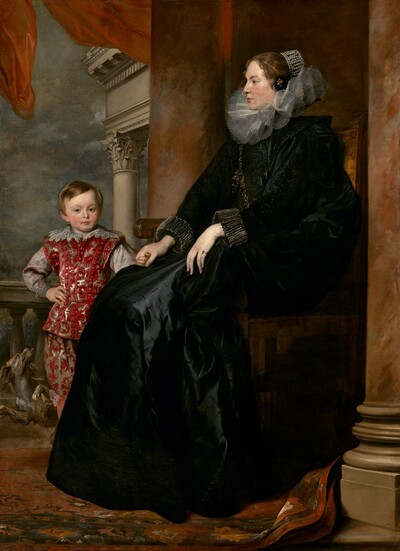
Susanna Fourment and Her Daughter from 1621 is a portrait by Anthony van Dyck (1599-1641) depicting the wife of the Antwerp merchant and art dealer Daniel Fourment, whose family van Dyck knew well—he would later paint several portraits of the Fourment family. The 1621 date places this in van Dyck's early Antwerp period, before his Italian years (1621-27) and his long residence in England (1632-41) as court painter to Charles I. The portrait demonstrates the elegant, flowing manner that distinguishes van Dyck's portraiture from the more austere manner of his master Rubens, and the intimacy of the mother-and-daughter subject shows van Dyck's gift for combining official elegance with personal warmth.
Cultural Impact
Susanna Fourment and Her Daughter is important in van Dyck's early oeuvre because it demonstrates the elegant, flowing manner that he was developing before his Italian years. The 1621 portrait shows the intimate warmth that would make van Dyck the most sought-after portrait painter in Europe—the combination of official elegance and personal warmth that distinguishes his best portraiture from Rubens's more physical manner.
Why It Matters
Susanna Fourment and Her Daughter is van Dyck's early portraiture developing its signature elegance: the wife of an Antwerp merchant rendered with the flowing grace and intimate warmth that would make him Europe's most sought-after portrait painter. The 1621 portrait shows his gift for combining official elegance with personal warmth.