Provenance
Painted for the sitter's husband, Peter Delmé [1748-1789], Titchfield Abbey, Hampshire; by descent to Seymour Robert Delmé, Cams Hall, Hampshire. Charles J. Wertheimer [1842-1911], London.[1] (Christie, Manson & Wood, London); purchased c. 1900-1901[2] by J. Pierpont Morgan, Sr. [1837-1913], New York; bequeathed to his daughter, Mrs. Robert L. Satterlee [d. 1946], who owned it until c. 1930. (Duveen Brothers, Inc., London and New York); sold 15 December 1936 to The A.W. Mellon Educational and Charitable Trust, Pittsburgh;[3] gift 1937 to NGA.
[1] Wertheimer's name is in the list of former collections given for the painting on the Duveen Brothers invoice (see note 3).
[2]_Connoisseur_ 3 (1901), 206, notes this portrait as recently sold to Pierpont Morgan
[3] The original Duveen Brothers invoice is in Gallery Archives, copy in NGA curatorial files.
Accession Number
1937.1.95
Medium
oil on canvas
Dimensions
overall: 238.4 x 147.2 cm (93 7/8 x 57 15/16 in.) | framed: 266.4 x 175.3 cm (104 7/8 x 69 in.)
Classification
Painting
Credit Line
Andrew W. Mellon Collection
Tags
Painting Neoclassical & Romantic (1751–1850) Oil Painting Canvas British Color: Yellow
Background & Context
Background Story
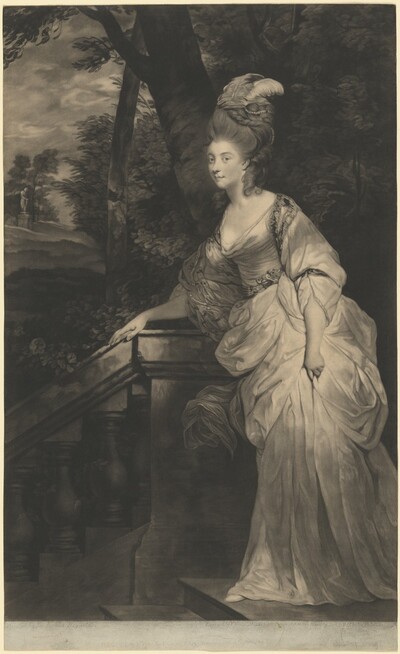
Lady Elizabeth Delmé and Her Children from 1777-79 is one of Reynolds's most celebrated group portraits, depicting the wife of the 4th Baronet Delmé with her children in a composition that combines the formality of aristocratic portraiture with the intimacy of a family group. Reynolds was the founder and first president of the Royal Academy, and his portraits set the standard for aristocratic portraiture in 18th-century Britain. The composition—which arranges Lady Delmé and her children in a landscape setting with the informality of a conversation piece rather than the rigidity of a state portrait—demonstrates Reynolds's ability to combine the grand style of history painting with the domestic subjects of portraiture.
Cultural Impact
Reynolds's group portraits are among the most influential works in the history of British painting because they established the visual convention of the aristocratic family group in landscape that would dominate British portraiture for the next century. Lady Elizabeth Delmé and Her Children is a canonical example of this convention: the family arranged in a landscape with the informal poses of a conversation piece but the compositional grandeur of a history painting.
Why It Matters
Lady Elizabeth Delmé and Her Children is Reynolds's grand style applied to aristocratic family portraiture: the wife and children of a baronet arranged in a landscape with the informal poses of a conversation piece and the compositional grandeur of a history painting. The portrait set the standard for British family portraiture for the next century.