Provenance
Possibly Gerard Vandergucht [1696-1776], London, c. 1750; possibly (his sale, London, 1757, no. 66); Jennens,[1] possibly for Henry Penton [d. 1806], London;[2] (his sale, Skinner & Dyke, London, 10 June 1800, no. 49); Sir Henry Paulet St. John-Mildmay, 3rd bt. [1764-1808], Dogmersfield House, Hampshire; by inheritance to his wife, Lady Jane St. John-Mildmay [c. 1765-1857], Dogmersfield House; by inheritance to her grandson, Sir Henry Bouverie Paulet St. John-Mildmay, 5th bt. [1810-1902], Dogmersfield House; by inheritance to his son, Sir Henry Paulet St. John-Mildmay, 6th bt. [1853-1916], Dogmersfield House; (M. Knoedler & Co., New York), from 1902; sold April 1905 to Andrew W. Mellon, Pittsburgh and Washington, D.C.; deeded 28 December 1934 to The A.W. Mellon Educational and Charitable Trust, Pittsburgh; gift 1937 to NGA.
[1] The only source to mention Vandergucht (also written van der Gucht) is the Knoedler prospectus for the painting, in NGA curatorial files, which mistakenly lists the Vandergucht sale of 1777 that did not include any paintings by Cuyp. See instead Frank Simpson, “Dutch Paintings in England before 1760,” _The Burlington Magazine_ 95 (January 1953): 41, who lists a "Landscape with Cattle, etc." by Cuyp as being no. 66 in a 1757 Vandergucht sale in London, where it was bought by “Jennens.” The listing appears in one of two manuscript volumes in the Victoria and Albert Museum library, London, that contain transcripts of catalogues of the principal collections of paintings sold in England between 1711 and 1759. Jennens was likely Charles Jennens, whom Simpson describes as having brought together by the mid-eighteenth century the largest collection of Dutch paintings then in England. Without further description or size information in the transcription, however, it is not possible to know whether the painting in question is identical to _Herdsmen Tending Cattle_.
[2] The Knoedler prospectus, in NGA curatorial files, says that Penton acquired the painting at the Vandergucht sale. Penton certainly owned the picture by 1760, the date on François Vivares’ reproductive engraving, entitled _The Evening_. It depicts the composition in reverse but, with the exception of a group of two birds, it is otherwise identical. This print is listed in Charles LeBlanc, _Manuel de l’amateur d’estampes_, 4 vols., Paris, 1854: 4:141, no. 20; and Andreas Andresen, _Handbuch für Kupferstichsammler..._, 2 vols., Leipzig, 1873: 2:678, no. 17.
Accession Number
1937.1.59
Medium
oil on canvas
Dimensions
overall: 66 x 87.6 cm (26 x 34 1/2 in.) | framed: 88.9 x 109.9 x 3.8 cm (35 x 43 1/4 x 1 1/2 in.)
Classification
Painting
Credit Line
Andrew W. Mellon Collection
Tags
Painting Baroque (1600–1750) Oil Painting Canvas Dutch
Background & Context
Background Story
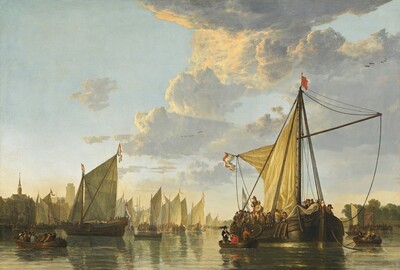
Aelbert Cuyp's Herdsmen Tending Cattle (1655/1660) embodies the Golden Age Dutch pastoral—the sun-drenched landscape where cattle, herdsmen, and expansive sky combine into an image of rural prosperity that defined Dutch landscape painting's most appealing mode. Cuyp, based in Dordrecht, developed a distinctive approach to landscape painting characterized by warm golden light—the influence of Italianate landscape painting filtered through Dutch atmospheric sensibility. His cattle scenes, which became his most popular and influential works, depict the animals not as agricultural stock but as noble inhabitants of a landscape that seems designed for their comfort. The herdsmen provide human presence and compositional focus while remaining subordinate to the landscape's expansive beauty. The 1655-60 date places this among Cuyp's most accomplished works, when he had fully developed his signature golden light and mastered the integration of figures, animals, and landscape into unified compositions. The cattle themselves—their breeds, their markings, their physical condition—document the Dutch Republic's agricultural prosperity, which was the economic foundation of the Golden Age itself. Dutch cattle breeding was among the most advanced in Europe, and the fine animals Cuyp paints embody national pride as surely as the ships in marine paintings.
Cultural Impact
Cuyp's cattle landscapes influenced English landscape painting more than any other Dutch genre. When English collectors began acquiring Dutch paintings in the 18th century, Cuyp was among the most sought-after artists, and his golden light directly influenced Constable, Gainsborough, and the Norwich School. The paintings influenced English agricultural art and the pastoral tradition that celebrated rural prosperity. Cuyp's fusion of Dutch observation with Italianate golden light created a template for landscape beauty that persisted in European painting for two centuries.
Why It Matters
This painting matters because it created the visual archetype of the sun-drenched pastoral landscape that has influenced European art, literature, and even landscape design for over three centuries. Every golden, cattle-dotted landscape painting from Constable to the present owes something to Cuyp's formulation. The painting demonstrates how a specific national art—Dutch landscape painting—can generate images of universal appeal when technique and sensibility achieve the right balance.