Provenance
Painted for the sitter's father, Frederick Howard, 5th earl of Carlisle [1748-1825], Castle Howard, Yorkshire; by descent[1] to the Hon. Geoffrey Howard [1877-1935], son of George, 9th earl of Carlisle, who sold it February 1926 to (Duveen Brothers, Inc., London and New York); purchased 3 February 1926 by Andrew W. Mellon, Pittsburgh and Washington, D.C.; deeded December 1934 to The A.W. Mellon Educational and Charitable Trust, Pittsburgh; gift 1937 to NGA.
[1] The addition of the 7th Earl of Carlisle to Ownership Detail below is per NGA curatorial files.
Accession Number
1937.1.106
Medium
oil on canvas
Dimensions
overall: 143 x 113 cm (56 5/16 x 44 1/2 in.) | framed: 167.3 x 138.7 cm (65 7/8 x 54 5/8 in.)
Classification
Painting
Credit Line
Andrew W. Mellon Collection
Tags
Painting Neoclassical & Romantic (1751–1850) Oil Painting Canvas British
Background & Context
Background Story
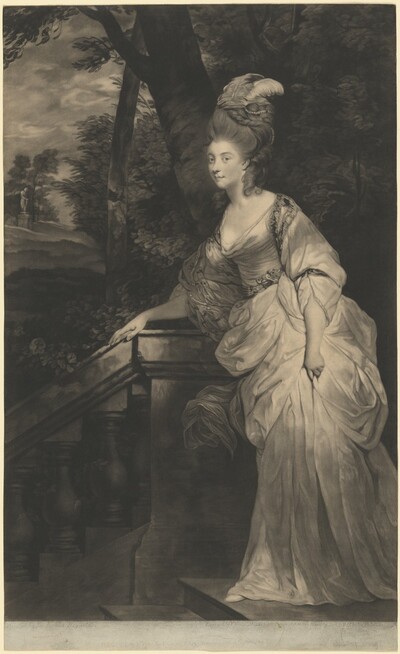
Lady Caroline Howard from 1778 is a portrait of the daughter of the 5th Duke of Marlborough, depicting the young woman with the idealized beauty and graceful pose that characterize Reynolds's best female portraiture. Reynolds's female portraits are notable for their combination of individual likeness and idealized beauty—he captures the sitter's features with enough accuracy to serve as a portrait while enhancing them with the grace and elegance that his aristocratic clients expected. The 1778 date places this in Reynolds's most productive period, when he was the most sought-after portrait painter in England.
Cultural Impact
Reynolds's female portraits established the visual conventions of aristocratic femininity that would dominate British portraiture for the next century. Lady Caroline Howard demonstrates the combination of individual likeness and idealized beauty that his clients expected: the features are accurate enough to serve as a portrait, but the grace and elegance transcend individual appearance to create an image of feminine beauty that serves as a cultural ideal.
Why It Matters
Lady Caroline Howard is Reynolds's aristocratic femininity at its most graceful: individual likeness combined with idealized beauty in a portrait that serves both as a record of a specific person and as an image of feminine elegance. The 1778 portrait demonstrates why Reynolds was the most sought-after portrait painter in England.