Provenance
Duke of Leuchtenberg, Munich and Saint Petersburg, by 1852;[1] sold 1933 through (Heinemann Galerie, Munich) to (Count Alessandro Contini Bonacossi, Florence);[2] sold December 1934 to the Samuel H. Kress Foundation, New York;[3] gift 1939 to NGA.
[1] See J.D. Passavant, _The Leuchtenberg Gallery. Collection of Pictures...of ...the Duke of Leuchtenberg at Munich_, Frankfurt and London, 1852: no. 44, repro.; A. Néoustroïeff, "I quadri italiani nella collezione del duca G.N. von Leuchtenberg di Pietroburgo," _Arte_ (1903): 338 (fig. 10), 341.
[2] Heinemann Galerie no. 18999 (sold paintings card; copy in NGA curatorial files).
[3] The bill from Contini Bonacossi to the Kress Foundation for five paintings, including _Madonna and Child_ by Bernardino Luini "from the Coll. of Prince Leuchtenberg, Petrograd," is dated 27 December 1934 (copy in NGA curatorial files). See also The Kress Collection Digital Archive, https://kress.nga.gov/Detail/objects/2224.
Accession Number
1939.1.152
Medium
oil on panel
Dimensions
overall: 43.8 x 40.3 cm (17 1/4 x 15 7/8 in.)
Classification
Painting
Credit Line
Samuel H. Kress Collection
Tags
Painting Renaissance (1400–1599) Oil Painting Panel Painting Italian
Background & Context
Background Story
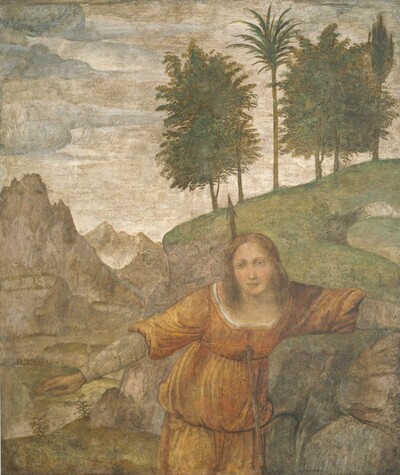
Bernardino Luini (c. 1480-1532) was a Lombard painter whose work is so deeply influenced by Leonardo da Vinci that attribution questions between the two artists have persisted for centuries. The Madonna of the Carnation from around 1515 shows Luini working in the Leonardesque style that defines his mature work: the soft sfumato modeling of the Virgin's face, the tender gesture of the Christ Child reaching for the carnation, and the pyramidal composition are all derived from Leonardo's Madonna compositions. The carnation itself was a symbol of divine love and of the Passion (its Greek name, dianthos, means 'flower of God'), and its inclusion in a Madonna painting connects maternal tenderness to Christ's future suffering.
Cultural Impact
Luini's Madonna paintings are among the most Leonardesque works in Lombard painting, and The Madonna of the Carnation demonstrates how deeply Leonardo's innovations in composition, modeling, and emotional expression were absorbed by his followers. The painting is not a copy but an interpretation—Luini uses Leonardo's compositional formulas to create a Madonna that is simultaneously Leonardesque in style and Luinian in its gentler emotional tone.
Why It Matters
The Madonna of the Carnation is Luini interpreting Leonardo: the soft sfumato, the pyramidal composition, and the tender gesture are all Leonardo's, but the gentleness of the emotional tone is Luini's own contribution. The carnation connects the Virgin's maternal love to Christ's future Passion—a symbol of divine love hidden in a gesture of tenderness.