Provenance
Niccolini, Florence. (Count Alessandro Contini Bonacossi, Florence and Rome); sold 1936 to the Samuel H. Kress Foundation, New York;[1] gift 1939 to NGA.
[1] See also The Kress Collection Digital Archive, https://kress.nga.gov/Detail/objects/1924.
Accession Number
1939.1.344.b
Medium
oil on canvas
Dimensions
overall: 27.9 x 41.9 cm (11 x 16 1/2 in.) | framed (upper left canvas, framed with 1939.1.344.a and .c): 86.52 x 114.3 x 9.21 cm (34 1/16 x 45 x 3 5/8 in.)
Classification
Painting
Credit Line
Samuel H. Kress Collection
Tags
Painting Renaissance (1400–1599) Oil Painting Canvas Italian
Background & Context
Background Story
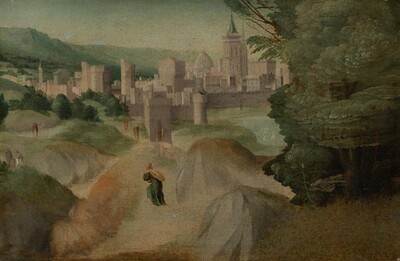
Scenes from a Legend is a painting by Giovanni Larciani, who is also known as the Master of the Kress Landscapes, dating to approximately 1515-1520. This dual identity reflects the scholarly history of an artist whose stylistic personality was first recognized in a group of landscape paintings in the Kress Collection before being linked to the documented Florentine painter Giovanni Larciani. The work depicts narrative episodes from a saintly or mythological legend arranged within a landscape setting, a format that was highly popular in early sixteenth-century Florence and reflects the period's growing interest in integrating figurative narratives within naturalistic environments. Larciani worked during a pivotal moment in Florentine art, when the innovations of the High Renaissance pioneered by Leonardo da Vinci, Michelangelo, and Raphael were being disseminated and adapted by a generation of talented but less famous painters. His landscape backgrounds show the influence of the developing tradition of Tuscan landscape painting, which moved beyond the schematic mountains and trees of earlier quattrocento works toward more convincing atmospheric effects and topographical detail. The choice of legend scenes as subject matter connected the work to a rich tradition of narrative painting in Florence, where the lives of saints and classical heroes were frequently represented in ways that combined devotional content with opportunities for landscape depiction and the portrayal of dramatic action. The early sixteenth century saw Florence undergoing profound political and cultural changes. The Medici family had returned to power in 1512, ending the republic that had been established in 1494, and the city was negotiating the tensions between its republican heritage and the reality of Medici control. In this context, paintings of legendary subjects—whether saints or ancient heroes—carried resonances that extended beyond their narrative content, touching on contemporary questions of virtue, power, and civic identity.
Cultural Impact
Larciani's work exemplifies how Florentine painters of the early cinquecento balanced the new landscape tradition with the city's long heritage of figurative narrative. His paintings also illustrate the role of so-called "minor masters" in transmitting and adapting the innovations of greater artists, making High Renaissance visual language available to a wider range of patrons and audiences than the most famous artists could serve.
Why It Matters
This painting matters as a representative work of a Florentine master of the early sixteenth century, documenting the transition from the narrative conventions of the quattrocento to the landscape-integrated compositions that would influence the development of mannerist and baroque narrative painting.