Provenance
Sold in or before 1858 by the artist's niece Margaretta Angelica Peale [1795-1882] to the artist's granddaughter Mary Jane Peale [1827-1902];[1] bequeathed to her sister-in-law Louise Harriet Hubley Peale [Mrs. Edward Burd Peale, b. 1839];[2] her daughter, Anna Frances Peale Carrier [Mrs. Frederick Carrier, 1860-1924]; sold on 5 December 1922 to Thomas B. Clarke [1848-1931], New York;[3] his estate; sold as part of the Clarke collection 29 January 1936, through (M. Knoedler & Co., New York), to The A. W. Mellon Educational and Charitable Trust, Pittsburgh; gift 1942 to NGA.
[1] Mary Jane Peale, in her "List of Pictures I Own, 1884," noted "43 Gen De Haas one of Washington's Generals - by Chas W Peale. This I bought from Margaretta Peale" (Peale-Sellers Collection, American Philosophical Society, Philadelphia). It is not known how Margaretta Peale obtained the painting; family lore later held that it was found in a Philadelphia attic (notes, William P. Campbell, 1957, in NGA curatorial file). The painting could be one of the "Pictures" left by de Haas to his wife Eleanor Bingham de Haas in his will, dated 21 February 1786. The inventory of the contents of his house, dated 13 July 1786, listed in the front parlor a "Mahogany Desk, Tea Table, Dining Table, 6 Chairs, 5 pictures &c." (Abram Hess, "The Life and Services of John Philip de Haas," in Lebanon County Historical Society, _Historical Papers and Addresses_ 7, no. 2 (February, 1916): 121, 124).
[3] The picture is listed in the codicil to her will dated 6 September 1901: "To Louisa wife of my brother Edward Gen de Haas if not sold painted by my grandfather" (will, proved 29 May 1903, Register of Wills, Pottsville, Pennsylvania; photocopy in NGA curatorial file).
[4] The name of the seller and the date of the purchase are recorded in a of _Portraits by Early American Artists of the Seventeenth, Eighteenth and Nineteenth Centuries Collected by Thomas B. Clarke_ (Exh. cat., Philadelphia Museum of Art, 1928) annotated with information from files of M. Knoedler & Co., NY (copy in NGA curatorial records and in NGA library). The painting was apparently purchased through Art House, Inc. (see correspondence in NGA curatorial files). Mrs. Carrier stated in an interview with Wilfred Jordan, Curator at Independence Hall, Philadelphia, on 3 October 1917, that the "portrait had been in the possession of her immediate family since painted by Charles Wilson Peale ... She has known the portrait intimately for fifty-two years, it having formerly belonged to her mother" (Wilfred Jordan, "Notes of an Interview Under Date of October 3rd, 1917, with Mrs. Carrier, 406 S. 16th St., Philada.," typescript; copy, NGA curatorial file).
Accession Number
1942.8.9
Medium
oil on canvas
Dimensions
overall: 127 x 101.6 cm (50 x 40 in.) | framed: 149.9 x 124.5 x 9.5 cm (59 x 49 x 3 3/4 in.)
Classification
Painting
Credit Line
Andrew W. Mellon Collection
Tags
Painting Neoclassical & Romantic (1751–1850) Oil Painting Canvas American
Background & Context
Background Story
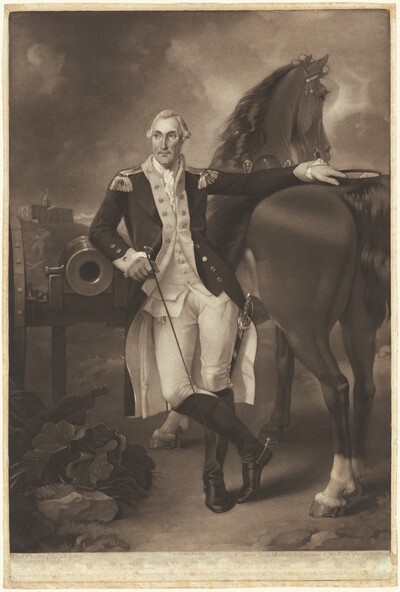
Charles Willson Peale's portrait of "John Philip de Haas" (1772) depicts a prominent Pennsylvania figure of the colonial and Revolutionary era, rendered with the directness and documentary precision that made Peale the most important American portrait painter of the late eighteenth century. De Haas was a German-born military officer who emigrated to Pennsylvania and became a brigadier general in the Continental Army during the American Revolution — a career trajectory that exemplifies the immigrant contribution to American independence.
Peale (1741–1827) was not only a painter but a polymath who founded the first major museum in the United States (Peale's Museum in Philadelphia), organized the first scientific expedition to exhenge and study prehistoric fossils, and was an active participant in the political and intellectual life of the new republic. His portraits of Revolutionary War leaders — including his famous gallery of heroes at Independence Hall in Philadelphia — created the visual iconography of the American founding that persists to this day.
This 1772 portrait dates from the period before the Revolution, when Peale was establishing himself as a portrait painter in the colonies after studying in London with Benjamin West. The painting shows de Haas in the convention of eighteenth-century gentlemen's portraiture: three-quarter length, turned slightly to present his best profile, his expression conveying the authority and self-possession appropriate to his social standing. Peale's technique at this point in his career combines the lessons of his London training — the careful modeling of features, the attention to the texture of fabric and the fall of light across the sitter's face — with a directness and sobriety that is characteristically American.
John Philip de Haas (c. 1722–1786) was born in the Rhineland Palatinate in present-day Germany and emigrated to Pennsylvania, where he became a successful merchant and militia officer. When the Revolution came, de Haas was appointed brigadier general in the Continental Army, making him one of the highest-ranking officers of German descent in the American forces. His portrait by Peale thus represents an important theme in American history: the role of immigrants — particularly German immigrants, who formed the largest non-English ethnic group in colonial America — in building and defending the new republic.
Peale's portrait of de Haas belongs to a broader practice of documenting the leaders of the American Revolution through portraiture. Peale understood that he was creating a visual record for posterity, and his portraits were intended to be both likenesses and historical documents. This dual purpose — to capture the individual and to preserve the memory of a historical moment — gives Peale's Revolutionary-era portraits an urgency and importance that transcends the genre of portraiture itself.
Cultural Impact
Peale's portraits of Revolutionary War leaders created the visual record of the American founding, shaping how subsequent generations would imagine the men and women who built the republic.
Why It Matters
This portrait of German-born General de Haas exemplifies Peale's dual achievement as portraitist and historian — documenting the face of a Revolutionary War leader while preserving the crucial role of immigrants in American independence.