Provenance
Bequeathed by the sitter [d. 1865], Washington, D.C., to her step-niece, Adelaide Thomason Talbot [Mrs. Isham Talbot, 1799/1800-1873], Washington, D.C.;[1] her daughter, Mary Louisa Talbot, Kentucky.[2] Virginia Collins Miller [Mrs. Thomas Miller, 1809-1892], Washington, D.C.;[3] her daughter, Anna Thornton Miller Murray [Mrs. Sterling Murray, 1836-1917], Leesburg, Va.[4] Sold 4 January 1922 on behalf of an unidentified descendant by (Mary H. Sully, Brooklyn, New York) to (Art House, Inc., New York);[5] Thomas B. Clarke [1848-1931], New York; his estate; sold as part of the Clarke collection on 29 January 1936, through (M. Knoedler & Co., New York), to The A. W. Mellon Educational and Charitable Trust, Pittsburgh; gift 1942 to NGA.
[1] Mrs. Thornton's will, dated June 1855 (Office of Public Records, Washington, D.C. lists the "Portraits by Stuart to Mrs. Talbot" (copy, NGA curatorial file). Adelaide Talbot was the daughter of James B. Thomason, William Thornton's step-brother, and became the third wife of Isham Talbot, United States senator from Kentucky (1815-1819 and 1820-1825); Anna Maria Brodeau Thornton, "History and Life od Dr. William Thornton," unpublished manuscript, 1828, unpaginated, Thornton Papers, Manuscript Division, Library of Congress, Washington, D.C.
[2] George C. Mason, _The Life and Works of Gilbert Stuart_, New York, 1879, 269; Museum of Fine Arts, "Portraits Painted by Stuart...taken from Mason's _Life and Works of Gilbert Stuart_." _Exhibition of Portraits Painted by Gilbert Stuart_, Boston, 1880, 58, no 614; letter of 4 June 1914 from Anna T. Murray to Charles Henry Hart (NGA curatorial file).
[3] Anna T. Murray to Charles Henry Hart, 4 June 1914; Virginia Miller was the wife of Dr. Thomas Miller, owner of the Thornton home on F Street, N.W., at the time of Mrs. Thornton's death (obituary of Anna M. Thornton, _Daily National Intelligencer_, 18 August 1865). How and when Mrs. Miller acquired the portraits is unknown. For Mrs. Miller's dates see her obituary in the (Washington) _Evening Star_, 6 June 1892.
[4] Letter of 4 June 1914 from Murray to Hart; Mrs. Murray, who was named after Mrs. Thornton, left her belongings to her two sisters, Virginia Miller and Sally Fendall, "asking them to dispose of them in a proper manner, after my debts are paid, making gifts of remembrance to the special friends whom I love" (copy of will, which was filed 28 November 1917; Circuit Court of Loudoun County, Leesburg, Virginia).
[5] Receipt dated 4 January 1922, signed by Mary H. Sully (NGA curatorial file). Art House, Inc., was founded by Thomas B. Clarke in 1891; from 1919 to 1931 Thomas B. Clarke, Jr., Charles X. Harris, Alice T. Bay, and Clarence J. Dearden owned the firm. Mary Sully and her colleague A.E. Rueff provided Clarke with the provenance of the portraits.
Accession Number
1942.8.26
Medium
oil on canvas
Dimensions
overall: 73.2 x 61.3 cm (28 13/16 x 24 1/8 in.) | framed: 90.2 x 77.5 x 10.6 cm (35 1/2 x 30 1/2 x 4 3/16 in.)
Classification
Painting
Credit Line
Andrew W. Mellon Collection
Tags
Painting Neoclassical & Romantic (1751–1850) Oil Painting Canvas American
Background & Context
Background Story
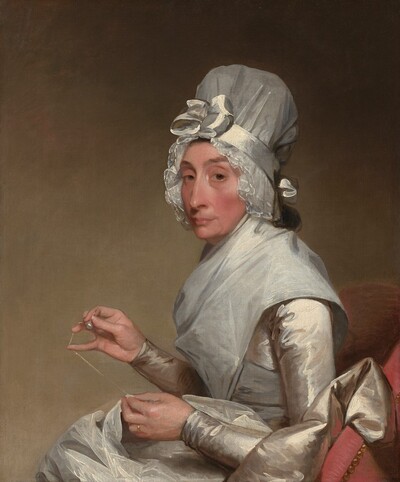
Gilbert Stuart's portrait of Anna Maria Brodeau Thornton (1804) depicts the wife of William Thornton, the architect who designed the United States Capitol. Painted in Washington, D.C., where Stuart had moved to find patrons among the new capital's political and social elite, the portrait exemplifies Stuart's mature style: confident brushwork, psychological insight, and the relaxed naturalism that distinguished American portraiture from European formality. Mrs. Thornton, as the wife of the Capitol's designer, embodied the Federal city's aspirations—the cultured, refined society that the new republic hoped to cultivate. The year 1804 finds the nation's capital still under construction, with Thornton's Capitol building unfinished and the city itself more aspiration than reality. Stuart's portrait captures the social confidence of a woman whose husband was literally building the nation's most important building. Stuart's handling combines the immediacy of direct observation—each brushstroke records a specific perception—with the composure appropriate to formal portraiture. His characteristic loose brushwork in the costume areas contrasts with more precise handling of the face, creating a hierarchy of attention that guides the viewer's eye.
Cultural Impact
Stuart's Washington portraits influenced how the early Republic's social elite was represented and remembered, establishing the visual standards for American portraiture that persisted through the 19th century. The Thornton portrait specifically influenced how the families associated with the capital's founding were culturally understood, contributing to the historical significance of the early Washington community. The portrait also influenced American women's portraiture by presenting a model of Federal-era femininity that combined cultivation with directness.
Why It Matters
This portrait matters because it connects the personal to the political: Mrs. Thornton's identity is inseparable from her husband's public achievement, yet Stuart reveals her as an individual rather than merely a wife. The portrait thus documents how the early Republic understood the relationship between public and private identity—a question that remains central to American political culture.