Provenance
Johan van der Linden van Slingeland [1701-1782], Dordrecht, by 1752;[1] (his estate sale, at his residence by Yver and Delfos, Dordrecht, 22 August 1785 and days following, no. 71); Fouquet.[2] Albert Dubois, Paris; (his sale, Le Brun and Julliot at Hôtel Bullion, Paris, 20 December 1785 and days following, no. 16, bought in). William Smith [1756-1835], Norwich;[3] sold privately to Edward Gray, who sold it in 1830.[4] Alexander Baring, later 1st baron Ashburton [1774-1848], Bath House, London, by 1834;[5] by inheritance in his family to Francis Denzil Edward Baring, 5th baron Ashburton [1866-1938], The Grange, Northington, Hampshire;[6] sold 1907 with the entire Ashburton collection to a syndicate of (Thomas Agnew & Sons, London; Arthur J. Sulley & Co., London; and Asher Wertheimer, London);[7] sold 1909 to Peter A.B. Widener, Lynnewood Hall, Elkins Park, Pennsylvania;[8] inheritance from Estate of Peter A.B. Widener by gift through power of appointment of Joseph E. Widener, Elkins Park, Pennsylvania; gift 1942 to NGA.
[1] Gerard Hoet, _Catalogus of Naamlyst van Schilderijen. . ._, 2 vols., The Hague, 1752, 2:495.
[2] The entry in the sale catalogue for no. 71 reads as follows: "CUYP (ALBERT) Op Doek, hoog 46, breed 66 duim. Een zeer capitaal Stuk, verbeeldende een ruim Landschap in den vroegen Morgenstond; by een aangenaam Zonligt, zeit men, op den Voorgrond, ter regterzyde, twee Heeren te paard, en daar nevens twee Landlieden rustende by hun Vee; ter linkerzyde een Herder by een staande en leggende Koe, waar by een Man die te paard komt aanrennen; verder ziet men een Rivier met Schepen gestoffeerd, en in't verschiet verscheide Gebouwen en hoog Gebergte; dit Konststuk is van een ongemeene schoone uitwerking, en een der beste van deezen Meester." An annotated copy of the auction catalogue at the Rijksbureau voor Kunsthistorische Documentatie, The Hague, notes that no. 71 was purchased by "Fouquet".
[3] Cited by Cornelis Hofstede de Groot, _A Catalogue Raisonné of the Works of the Most Eminent Dutch Painters of the Seventeenth Century_, trans. Edward G. Hawke, 8 vols., London, 1907-1927: 2(1909):131, no. 430.
[4] John Smith, _A Catalogue Raisonné of the Works of the Most Eminent Dutch, Flemish and French Painters_, 9 vols., London, 1829-1842: 5(1834):288. Perhaps this was the same Edward Gray, of Harringay Park, Hornsey, whose collections were auctioned at Christie's, London, May 1839.
[5] Smith 1829-1842: 5(1834):288. Baring, who was made Baron Ashburton in 1835, was a notable politician (architect of the 1842 Webster-Ashburton Treaty with the United States), and connoisseur (trustee of the British Museum and of London's National Gallery).
[6] Bath House was sold in 1890 by the 5th baron Ashburton, and he had the orangery at The Grange converted into a picture gallery that doubled as a ballroom.
[7] "Ashburton Collection Sold," _American Art News_ (19 October 1907): 1. Hofstede de Groot, in both the German (1908) and English (1909) editions, lists the painting as being with Agnew. The painting is listed among those handled by Asher Wertheimer in Norman L. Kleeblatt, ed., _John Singer Sargent: Portraits of the Wertheimer Family_, exh. cat., The Jewish Museum, New York, 1999: 51.
[8] Widener collection records, in NGA curatorial files, list the painting as purchased from Sulley.
Accession Number
1942.9.16
Medium
oil on canvas
Dimensions
overall: 120 x 171.5 cm (47 1/4 x 67 1/2 in.) | framed: 164.2 x 214.3 x 17.2 cm (64 5/8 x 84 3/8 x 6 3/4 in.)
Classification
Painting
Credit Line
Widener Collection
Tags
Painting Baroque (1600–1750) Oil Painting Canvas Dutch
Background & Context
Background Story
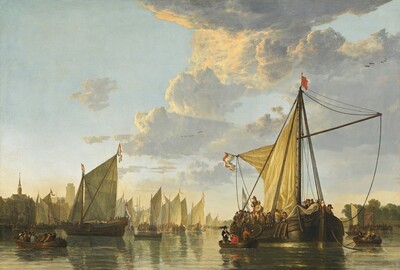
Horsemen and Herdsmen with Cattle (1655/1660) combines two of Cuyp's most characteristic subjects—equestrian figures and pastoral cattle—into a single composition that spans Dutch society from aristocratic riders to working herdsmen. The horsemen, elegantly dressed and mounted on fine horses, represent the regent class—Dordrecht's merchant-aristocrats whose wealth sustained the Republic. The herdsmen, modestly dressed and managing cattle, represent the agricultural labor that underwrote this wealth. Cuyp's composition places both groups within a landscape bathed in golden light, suggesting social harmony rather than class conflict—a vision of Dutch society as a unified productive body. This social vision was characteristic of Dutch Golden Age painting, which typically represented class differences as complementary rather than antagonistic. The 1655-60 date places this among Cuyp's most ambitious compositions, when he was expanding his narrative and social range beyond simple pastoral scenes. The painting also reflects the Dutch Republic's self-image: a society where different classes worked together for common prosperity, where wealth was visible but not ostentatious, and where landscape itself seemed to endorse the social order by providing beauty and abundance in equal measure.
Cultural Impact
Cuyp's combined equestrian-pastoral paintings influenced how European aristocratic pastoral life was represented in art, establishing conventions for depicting the landed gentry within their agricultural estates that persisted through English sporting art to 19th-century genre painting. The paintings influenced English landscape designers who created park landscapes combining cattle grazing with aristocratic riding—landscapes modeled partly on Cuyp's visual formulations.
Why It Matters
This painting matters because it reveals how landscape painting can encode social relationships within apparently natural scenes. Cuyp's landscape is not merely a beautiful place—it is a social order made visible, where horsemen and herdsmen coexist in a hierarchy ordained by nature's golden light. Understanding this dimension of Dutch landscape painting enriches our appreciation of works that superficially seem merely decorative but actually carry complex social and political implications.