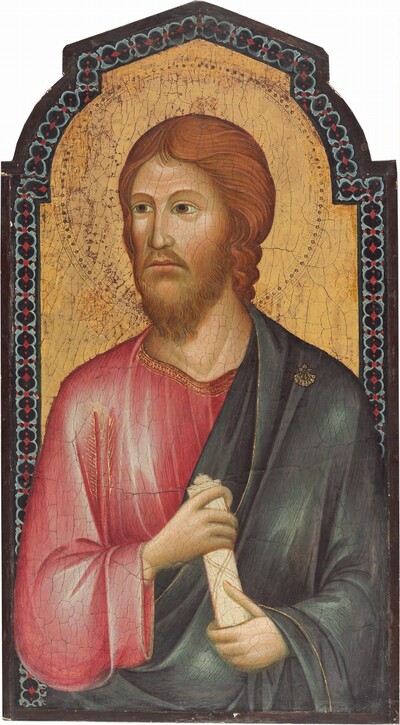
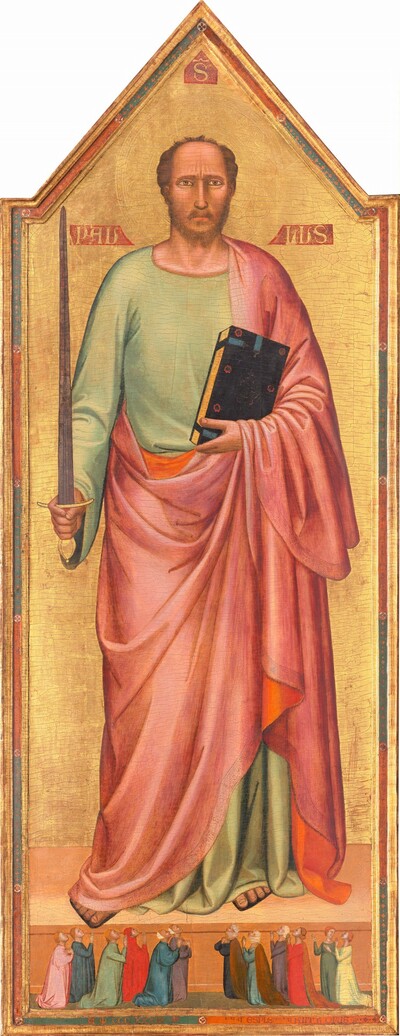
![The Saint Anne Altarpiece: Saint Nicholas [left panel]](https://image.artoryworks.com/iiif/8d5e54e2-78be-4d80-b526-700e9746916e.webp)
Provenance
Cardinal Antonio Despuig y Dameto [d. 1813], Raxa, Palma de Mallorca; by descent to Counts of Montenegro, Raxa, Palma de Mallorca.[1] Leon de Somzée, Brussels, by 1899.[2] Gaston de Somzée, Brussels;[3] purchased May 1902 through (Charles Fairfax Murray) by (Agnew & Sons, London); sold January 1906 to (Sedelmeyer Gallery, Paris).[4] (Eugene Fischhof, Paris and New York); sold April 1907 to Peter A. B. Widener, Lynnewood Hall, Elkins Park, Pennsylvania;[5] inheritance from Estate of Peter A. B. Widener by gift through power of appointment of Joseph E. Widener, Elkins Park, Pennsylvania; gift 1942 to NGA.
[1] The first mention of the painting is Joaquín María Bover, _Noticia Histórica-Artística de los Museos del Eminetísimo Señor Cardinal Despuig Existentes en Mallorca_ (Palma, 1845), 178, no. 152, 194, no. 207, and 195, no. 216. See also Karl Justi, "Altflandrische Bilder in Spanien und Portugal," _Zeitschrift für Kunstgeschichte_ 21 (1886), 137-138. For the life of Cardinal Despuig, see Luis Ripoll, _Raxa y el Cardinal Despuig_ (Palma de Mallorca, 1954), 8-15, and Jaime Salva, _El Cardinal Despuig_ (Palma de Mallorca, 1964).
[2] _Exhibition of Pictures by Masters of the Flemish and British Schools including a Selection from the Works of Sir Peter Paul Rubens_ (London, The New Gallery, 1899-1900), no. 52.
[3] _Exposition des Primitifs flamands et d'art ancien_ (Bruges, Hôtel de Gouvernement Provincial, 1902), no. 125, lists C. and G. de Somzée, but Sedelmeyer Gallery, _Illustrated Catalogue of the Tenth Series of 100 Paintings by Old Masters_ (Paris, 1906), 9, lists Gaston de Somzée.
[4] Agnew's Picture Stock Book no. 9, pp 256-7 and no. 10, pp. 24-25, National Gallery London Reference no. NGA 27/1/1/9-10 (copies NGA curatorial files).
[5] Unpublished document from the Widener papers in the NGA curatorial files that appears to be a copy of a receipt of 1 April 1907; the transaction was part purchase, part exchange, with Fischhof receiving an _Assumption of the Virgin_ by Murillo. Fischhof is not mentioned in the provenance given in _Catalogue of Paintings forming the Private Collection of P.A.B. Widener_ (Ashbourne, Pennsylvania, 1908), 155.
Accession Number
1942.9.17.a
Medium
oil on panel
Dimensions
painted surface (including addition at top): 234 x 74.9 cm (92 1/8 x 29 1/2 in.) | overall (panel): 236.1 x 75.7 cm (92 15/16 x 29 13/16 in.)
Classification
Painting
Credit Line
Widener Collection
Tags
Painting Renaissance (1400–1599) Oil Painting Panel Painting Netherlandish
Background & Context
Background Story
Gerard David (c. 1460-1523) was a Netherlandish painter known as the last great master of the early Netherlandish tradition, whose devotional paintings combine the precise observation of the early Netherlandish tradition with a softer, more atmospheric manner. The Saint Anne Altarpiece: Saint Nicholas from c. 1500/1520 is a left panel from a multi-panel altarpiece depicting Saint Nicholas, in the precise, devotional manner that David and his workshop produced for the many altarpiece commissions that made him one of the most successful painters in Bruges. The c. 1500/1520 date places this in David's mature period, when he was running the most successful workshop in Bruges.
Cultural Impact
The Saint Anne Altarpiece is important in the history of Netherlandish painting because it demonstrates the precise, devotional manner that David and his workshop brought to altarpiece painting as the last great master of the early Netherlandish tradition. David's combination of precise observation with softer atmospheric effect—maintaining the early Netherlandish tradition while developing it in a more atmospheric direction—represents the final phase of the early Netherlandish tradition, and the c. 1500/1520 altarpiece shows this tradition at its most accomplished.
Why It Matters
The Saint Anne Altarpiece: Saint Nicholas is Gerard David and Workshop at their most accomplished: the precise, devotional manner of the last great master of the early Netherlandish tradition. The c. 1500/1520 altarpiece panel shows David maintaining the early Netherlandish tradition while developing it in a more atmospheric direction.
![The Saint Anne Altarpiece: Saint Anthony of Padua [right panel]](https://api.nga.gov/iiif/5ef4c2b2-4df1-43d0-aaac-21ee5bef1fcd/full/400,/0/default.jpg)
![The Saint Anne Altarpiece: Saint Anne with the Virgin and Child [middle panel]](https://image.artoryworks.com/iiif/072919d5-cf19-4605-8c9c-a85267f9ca96.webp)