Provenance
Painted for the sitter's mother, Elizabeth, Duchess of Hamilton and Brandon [1734-1790]; by descent through her second husband, John, 5th Duke of Argyll [1723-1806], to George, 8th Duke of Argyll [1723-1806]; (sale, Christie, Manson & Woods, London, 17 March 1855, no. 91); bought by the King for Welbore Ellis, 2nd Earl of Normanton [1778-1868], Somerley, Hampshire; by descent to Sidney, 4th Earl of Normanton [1865-1933];[1] sold 22 March 1909 to (Thos. Agnew & Sons, London); sold the same day to (Arthur J. Sulley & Co., London);[2] purchased 1909 by Peter A.B. Widener, Lynnewood Hall, Elkins Park, Pennsylvania; inheritance from Estate of Peter A.B. Widener by gift through power of appointment of Joseph E. Widener; gift 1942 to NGA.
[1] The additional Dukes of Argyll and 3rd Earl of Normanton listed in the former owner table in NGA's collection database are per The Getty Provenance Index, and NGA curatorial records.
[2] Agnew stock books, recorded by The Getty Provenance Index.
Accession Number
1942.9.75
Medium
oil on canvas
Dimensions
overall: 117 x 84 cm (46 1/16 x 33 1/16 in.)
Classification
Painting
Credit Line
Widener Collection
Tags
Painting Neoclassical & Romantic (1751–1850) Oil Painting Canvas British
Background & Context
Background Story
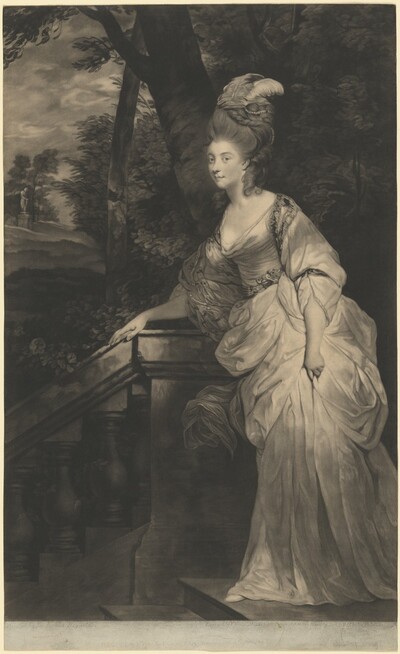
Lady Elizabeth Hamilton from 1758 is an early work by Reynolds, painted before he had fully developed the grand style that would make his reputation. The 1758 date places this in the period when Reynolds was establishing his practice in London after returning from his formative years in Italy, and the portrait shows the influence of Italian painting—particularly the compositional models of Raphael and Titian—on his developing style. Lady Hamilton's pose and the landscape setting derive from the Italian portrait tradition, but the handling of paint and the observation of the sitter's features are already distinctly Reynolds's own.
Cultural Impact
Early Reynolds portraits like Lady Elizabeth Hamilton are important documents in the development of British portraiture because they show the Italian influences that Reynolds synthesized into a distinctly British style. The 1758 portrait demonstrates the Raphael-like composition and Titian-like color that Reynolds learned in Italy, combined with the direct observation of individual character that would become his most distinctive contribution to British portraiture.
Why It Matters
Lady Elizabeth Hamilton is early Reynolds learning from Italy: the compositional models of Raphael and the color of Titian combined with the observation of individual character that would become his distinctive contribution to British portraiture. The 1758 portrait shows the Italian influences that Reynolds would synthesize into a distinctly British grand style.