Provenance
Cardinal Giulio Mazarini, called "Mazarin" [1602-1661], Paris, by September 1653;[1] by inheritance to Armand-Charles de la Porte, marquis de la Meilleray, duc de Mazarin [1632-1713; husband of the Cardinal's niece, Hortense Mancini], Paris; purchased on the marquis' death by Claude Louis Hector, duc de Villars [1653-1734]; by inheritance to his son, Honoré-Armand, duc de Villars, prince de Martigues [1702-1770], Château des Aygalades, Bouches-du-Rhône; acquired on the duc's death, with the château, by Mr. Mestre d'Aygalades; purchased with the château by Mr. Barras de la Penne; displayed 1819 by him, supposedly for sale, at the Hôtel des Archives du Royaume, Paris;[2] purchased by a Russian nobleman, St. Petersburg; traced and brought back to France by Louis-Joseph-Alphonse-Jules, comte de Castellane [1782-1861], who had acquired the Château des Aygalades;[3] his heirs; sold 1901 to (Duveen Brothers, Inc., London, New York, and Paris);[4] purchased 1901 by J. Pierpont Morgan [1838-1913], London and New York; by inheritance to his son, J. Pierpont Morgan, Jr. [1867-1943], New York; sold April 1916 to (P.W. French and Company, New York);[5] purchased 11 May 1916 by Joseph E. Widener, Lynnewood Hall, Elkins Park, Pennsylvania;[6] inheritance from Estate of Peter A.B. Widener by gift through power of appointment of Joseph E. Widener; gift 1942 to NGA.
[1] The provenance given here is based on George Henry McCall, _The Joseph Widener collection. Tapestries at Lynnewood hall, Elkins Park, Pennsylvania_, Philadelphia, 1932: 47, and expanded by the research of Dr. Candace Adelson.
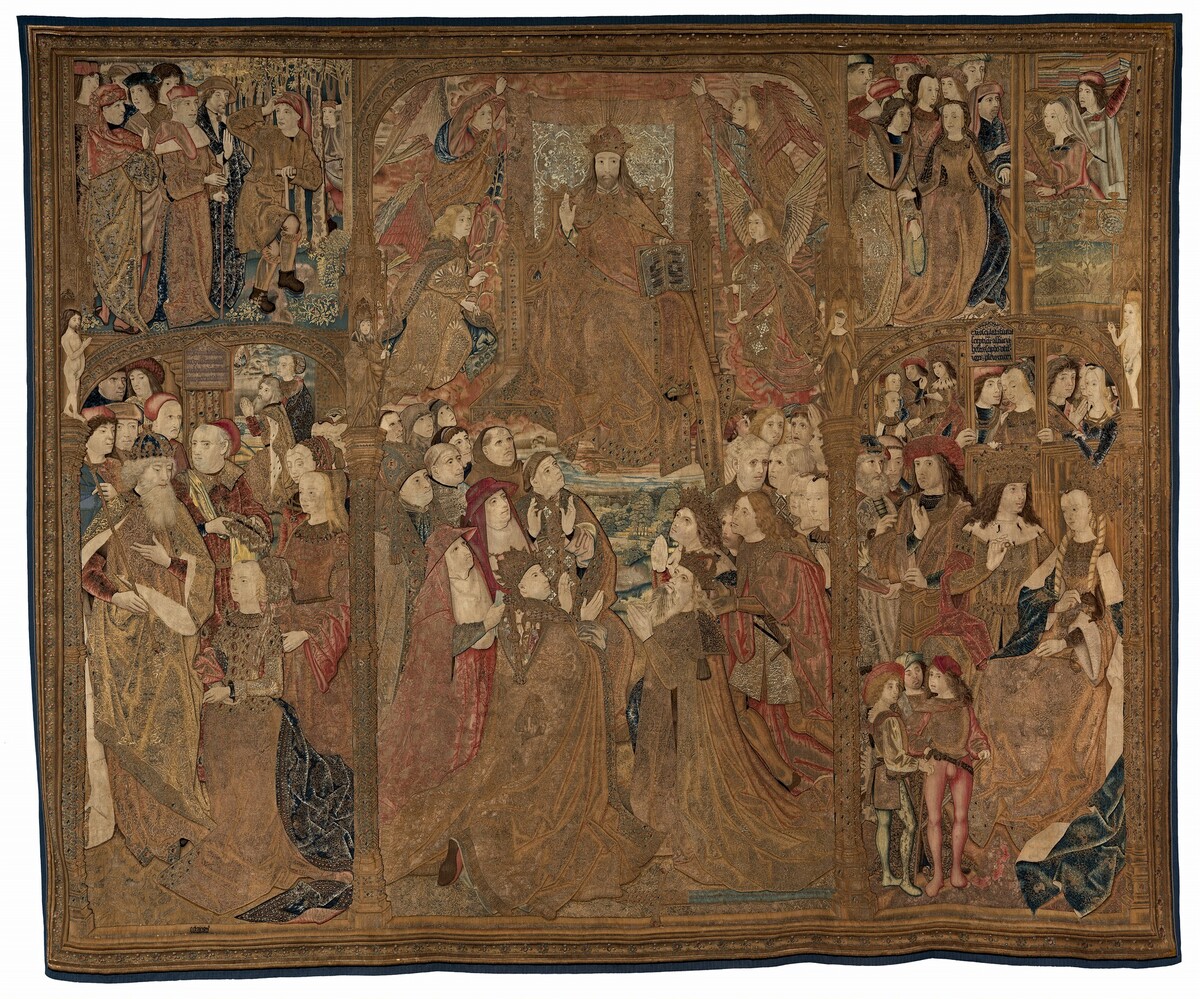
Roger-Armand Weigert, "L'âge d'or de la tapisserie flamande et les collections de Mazarin," in _De Bloeitijd van de vlaamse tapijtkunst, Internationaal Colloquium, 23-25 mei 1961_, Brussels, 1969: 423-424, disagreed with the traditional provenance from Cardinal Mazarin, stating that the tapestry did not appear in either of the Mazarin inventories, made in 1653 and 1661. However, Gertrude Townsend, then curator of textiles at the Museum of Fine Arts, Boston, pointed out to John Walker in letters of 21 and 27 January 1943 (in NGA curatorial files), that the tapestry did correspond with no. 1735 of the 1661 inventory, despite a slight difference in dimensions, an argument also accepted by Jean-Paul Asselberghs, _Les tapisseries flamandes aux Etats-Unis d'Amérique_, Brussels, 1974: 43-44. The 1661 description ("Post-mortem inventory of Cardinal Mazarin, May 1661, Bibliothèque, Paris, _Mélanges de Colbert_, 75: fol. 449r; published in Gabriel-Jules, comte de Gosnac, _Les Richesses du Palais Mazarin_, 2nd ed., Paris, 1885: 400, no. 1735) reads: "1735. Une autre pièce de tapisserie, fabrique d'Angleterre, de laine et soie relevée d'or, très riche, représentant _Dieu le Père dans un trône_, quatre anges à ses costez, et quantité d'histoires du Vieil et Nouveau Testament, avecq sa petite bordure parsemée de pierreries fines relevées d'or, haulte de deux aulnes trois quarts et large de trois aulnes et demye ou environ, prisée à la somme de six cent cinquante livres, cy -- 650 L. [livres] T."
Sophie Schneebalg-Perelman, "Un nouveau regard sur les origines et le développement de la tapisserie bruxelloise du XIVe siècle à la pré-Renaissance," in _Tapisseries bruxelloises_, 1976: 183, suggests that some of the English attributions in 17th-century French inventories reflect provenance, and it is known Mazarin acquired many pieces in his collection from England. His agent followed the sales of Charles I's collection from 1649 to 1653, but none of the king's listed tapestries can be matched to the NGA piece; for instance, the two pieces of _Christ Sitting in Judgment_ were too large (about 35 square meters each). A Charles I provenance cannot entirely be ruled out, however; many descriptions are of sets, or are imprecise, for instance the expensive _Divers Storys_ at Whitehall (L. 22, no dimensions); see W.G. Thomson, _A History of Tapestry From the Earliest Times until the Present Day_, London, 1906: 361, no. 3; 389, no. 968.
The NGA tapestry is also identifiable in Mazarin's earlier 1653 inventory by its dimensions and type of border ("Inventory of Cardinal Mazarin's effects, 12 September 1653," in Jean-Baptiste Colbert, _Inventaire de tous les meubles du Cardinal Mazarin Dressé en 1653_, London, 1861: 146): "Une autre pièce de tapisserie de laine et soie, fabriquee d'Angleterre, représentant diverses histoires du Vieux Testament en trois arcades, les figures moindres que le naturel, et une bordure fort estroite, parsemée de perles et pierreries, haute de deux aunes deux tiers et demi, large de trois aunes et demie moins un pouce."
[2] McCall 1932: 47, gave the date as 1824.
[3] McCall 1932, 47, attributes the return of the tapestry to Les Aygalades to Jules de Castellane's better-known nephew, Esprit-Victor-Boniface. The château belonged, however, to Jules, a noted amateur. See Esprit-Victor-Elisabeth-Boniface de Castellane, _Journal du Maréchal de Castellane 1804-1862_, 5 vols., Paris, 1895-1897: 2:314-315; 5:217, and M. Prevost and Roman d'Amat, _Dictionnaire de Biographie française_, Paris, 1951-: a.v. Castellane, no. 23.
[4] Gustave Migeon, _Les Arts du tissu_, Paris, 1909: 238, says Morgan bought the tapestry from a certain Chabrière, whom Hermann Schmitz (_Bildteppiche: Geschicte der Gobellinwirkerei_, Berlin, 1919: 206), infers to be the Lyon collector Chabrières-d'Arles. It might also have been the Castellane heir(s), or representative. Edward Fowles, _Memories of Duveen Brothers_, London, 1976: 21, says the tapestry was offered in 1901 from the south of France to Duveen, who resold it to Morgan.
[5] The high price paid for the tapestry, first by French & Co. and shortly thereafter by Widener, made newspaper headlines; see _The New York Times_ (21 April 1916): 9, and _New York Tribune_ (30 April 1916): n.p., repro.
[6] Edith A. Standen, Widener collection curator, ms. note on Widener collection card, in NGA curatorial files.
Accession Number
1942.9.446
Medium
tapestry: undyed wool warp; dyed wool, silk, and silver-gilt- and silver-wrapped silk weft
Dimensions
overall: 341 x 439.4 cm (134 1/4 x 173 in.)
Classification
Decorative Art
Credit Line
Widener Collection