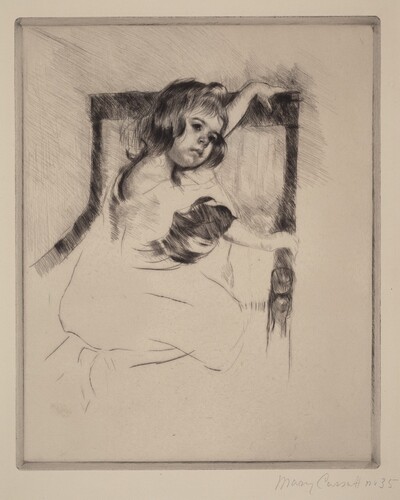
Accession Number
1943.3.2764
Medium
color drypoint, softground etching, and aquatint on laid paper
Dimensions
plate: 36.51 × 26.67 cm (14 3/8 × 10 1/2 in.) | sheet: 44.1 × 27.2 cm (17 3/8 × 10 11/16 in.)
Classification
Credit Line
Rosenwald Collection
Tags
Print Impressionist & Modern (1851–1900) Etching Paper American
Background & Context
Background Story
The Bath (c. 1891-1892) is perhaps Cassatt's most famous work, depicting a mother washing her child—a subject that combines intimate maternal care with the compositional boldness that Japanese prints inspired. The painting exists in multiple versions: a painting and a print, with the print version being one of Cassatt's most celebrated achievements. The bath, as a daily ritual of maternal care, provided Cassatt with the perfect subject for her artistic concerns: it combined the physical intimacy of mother and child, the domestic setting that was women's domain, and the compositional opportunities of the basin, the water, and the figures' interlocking forms. The 1891-92 date places this during Cassatt's most productive printmaking period, when Japanese aesthetics were transforming her approach to composition. The low viewpoint—looking at the scene from the child's level—is derived from Japanese compositions and creates an unusual perspective that emphasizes the mother's care rather than her social position. The mother's hands, washing the child's body, become the painting's emotional center—the gesture of care that defines the maternal relationship. Cassatt's handling of the interlocking forms—mother and child, basin and water, figure and setting—creates a visual unity that reflects the emotional unity of the subject.
Cultural Impact
Cassatt's The Bath influenced how maternal care was represented in Western art, establishing intimate physical care as a subject worthy of serious artistic treatment. The painting influenced later women artists and feminist art historians who similarly sought to represent domestic care as significant rather than trivial. The Bath influenced how Japanese composition was integrated into Western art, demonstrating that cross-cultural borrowing could produce unified artistic achievements rather than fragmented pastiche.
Why It Matters
This painting matters because it represents the most successful integration of Cassatt's artistic concerns: maternal subject, Japanese composition, and the domestic interior as significant artistic space. The Bath argues that the daily rituals of maternal care—the washing, the holding, the constant attention—are not merely domestic routine but the foundation of human civilization, and that art's highest calling is to honor these rituals with the seriousness they deserve.