Provenance
Commissioned c. 1522 by Gerolamo Rabia for either the Casa Rabia, Milan, or his country house, La Pelucca, near Monza.[1] Michele Cavaleri, Milan; sold 1873 to Enrico (Henri) Cernuschi [1821-1896], Paris and Menton, until at least 1895.[2] (Charles Sedelmeyer, Paris), by 1897.[3] Rodolphe Kann [d. 1905], Paris, by 1900;[4] his estate; sold 1907 to (Duveen Brothers, Inc., London, New York, and Paris); sold 1942 to the Samuel H. Kress Foundation, New York;[5] gift 1943 to NGA.
[1] See the discussion in Fern Rusk Shapley, _Catalogue of the Italian Paintings_, 2 vols., Washington, D.C., 1979: 1:285-288. If the frescoes were in the Casa Rabia, on the Piazza San Sepolcro in Milan, the house passed out of the family about 1530, but the paintings remained in place since they were not removed until about 1800. Among the subsequent owners of the house were the Palletta and Silva families.
[2] The ownership of the frescoes by Cavaleri and Cernuschi, as well as other information about the provenance is discussed in detail by Luca Beltrami, _Luini, materiale de studio_, Milan, 1911: 188-198. Cavaleri was a Milanese lawyer who began collecting around 1845 and from 1870 on opened to the public what by then had come to be called the Cavaleri Museum. The owner hoped that the collection would be purchased by the city of Milan, but when negotiations fell through, he sold the entire collection to Cernuschi on 13 April 1873 (see Alessandra Mottola Molfino, "Collezionismo e mercato artistico a Milano," in _Zenale e Leonardo. Tradizione e rinnovamento della pittura lombarda_, Milan, 1982: 247-248). Cernuschi was a Milanese emigrant to France, and as he otherwise collected mainly objects of Asian Art (see Caroline Gyss-Vermande, "Cernuschi, Henri," in _Dictionary of Art_, 34 vols., New York, 1996: 6:345), it is likely he obtained his Italian paintings from the Cavaleri collection.
[3] Charles Sedelmeyer, [catalogue], Paris, 1897: nos. 52-60.
[4] _Gemälde-Sammlung des Herrn Rudolf Kann in Paris. 100 Photogravuren mit Text von Wilhelm Bode_, Vienna, 1900.
[5] Fern Rusk Shapley, _Paintings from the Samuel H. Kress Collection: Italian Schools, XV-XVI Century_, London, 1968: 141-142. See also The Kress Collection Digital Archive, https://kress.nga.gov/Detail/objects/466.
Accession Number
1943.4.53
Medium
fresco
Dimensions
overall: 221.6 x 150.2 cm (87 1/4 x 59 1/8 in.)
Classification
Painting
Credit Line
Samuel H. Kress Collection
Tags
Painting Renaissance (1400–1599) Italian
Background & Context
Background Story
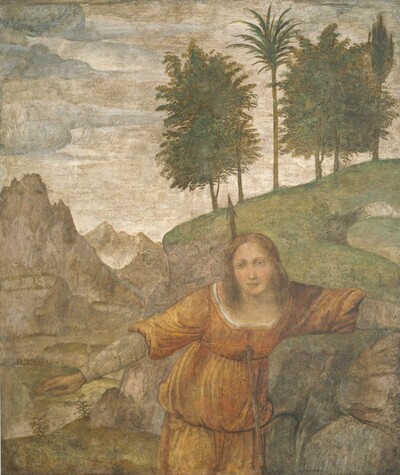
Cephalus Hiding the Jewels is a fresco fragment from a larger decorative scheme, depicting a scene from the mythological story of Cephalus and Procris. Luini's fresco style—lighter, brighter, and more decorative than his oil paintings—was well suited to the narrative demands of wall decoration, where clarity of storytelling was as important as aesthetic refinement. The mythological subject (from Ovid's Metamorphoses) was appropriate for a secular decorative scheme in a Lombard palazzo, where classical mythology provided the narrative content that the Counter-Reformation reserved for churches.
Cultural Impact
Luini's fresco fragments demonstrate the range of his decorative ability, from the narrative clarity of the mythological scenes to the tender modeling of his Madonna paintings. The Cephalus fragment shows his ability to handle a dramatic narrative subject with the same compositional grace that he brought to his more intimate works. The fresco medium suits his style: the bright, clear colors and the simplified forms are more effective on a wall than in an altarpiece.
Why It Matters
Cephalus Hiding the Jewels is Luini's fresco style at its most narrative: a mythological scene rendered with the clarity that wall decoration demands and the grace that distinguishes all his work. The fresco medium brings out the bright, decorative side of Luini's Leonardesque style—the side that makes his work feel both Italian Renaissance and Lombard garden party.