Provenance
Painted for Jeanne Antoinette Poisson, marquise de Pompadour [1721-1764] and installed in the _appartement des bains_ in the Château de Bellevue, outside Paris; removed c. 1757; recorded 1764 in the vestibule of the ground floor of the Hôtel d'Evreux, Pompador's Parisian residence; by inheritance to her brother, Abel François Poisson, marquis de Ménars et de Marigny [1727-1781], Château de Ménars, Paris; installed in the gallery of Marigny's residence, rue St. Thomas du Louvre, Paris, by 1777;[1] (his estate sale, at his residence by Basan and Joullain, Paris, 18 March-6 April 1782 [postponed from late February], no. 21); purchased by Jean Baptiste Pierre Le Brun [1748-1813], Paris and London.[2] Baron Alfred Charles de Rothschild [1842-1918], Halton House, near Wendover, Buckinghamshire, by 1884;[3] bequest to Grace Elvina Hinds Duggan Curzon, marchioness of Curzon [1879-1958], Kedleston Hall, Derby, Derbyshire; (her sale, American Art Association-Anderson Galleries, New York, 22 April 1932, no. 80); Chester Dale [1883-1962], New York; gift 1943 to NGA.
[1] The painting was recorded there in 1777, when the marquis had them cleaned by Hoogstael. The documents, in the Archives de la Ville in Paris, Fonds Marigny, NA 102, fol. 90 verso, were discovered by Alden Gordon, and his notes from them were sent with a letter to David Rust dated 15 March 1983, all in NGA curatorial files.
[2] Paul Matthews, of the Dulwich Picture Gallery, kindly brought to the Gallery's attention a Boucher _Venus and Cupids_ that appeared in the 1785 sale of Noël Desenfans (d. 1807), a dealer who was one of Le Brun's business partners (sale, Christie's, London, May 11-14, 1785, 2nd day, no. 53; e-mail to Curatorial Records, 6 May 2004, NGA curatorial files). There is no description of the painting in the sale catalogue, so it is not possible to say with certainty that this was the Gallery's painting. The purchaser at the 1785 sale was recorded as "Dillon," who also purchased two other lots. Marijke Booth, of Christie's Archives Department, suggests that this could either be Charles Dillon-Lee, 12th viscount Dillon (1745-1813) or Edward Count Dillon (1751-1839), both collectors during this period (e-mail to Anne Halpern, 9 August 2007, NGA curatorial files).
[3] Alfred did not inherit the painting from his father, and the painting is not included in Alfred's 1884 catalogue, so he must have acquired it himself at a later date (e-mail from Michael Hall, curator to Edmund de Rothschild, to Anne Halpern, 3 August 2008, NGA curatorial files).
Accession Number
1943.7.2
Medium
oil on canvas
Dimensions
overall: 107 x 84.8 cm (42 1/8 x 33 3/8 in.) | framed: 132.1 x 110.2 x 7.6 cm (52 x 43 3/8 x 3 in.)
Classification
Painting
Credit Line
Chester Dale Collection
Tags
Painting Neoclassical & Romantic (1751–1850) Oil Painting Canvas French
Background & Context
Background Story
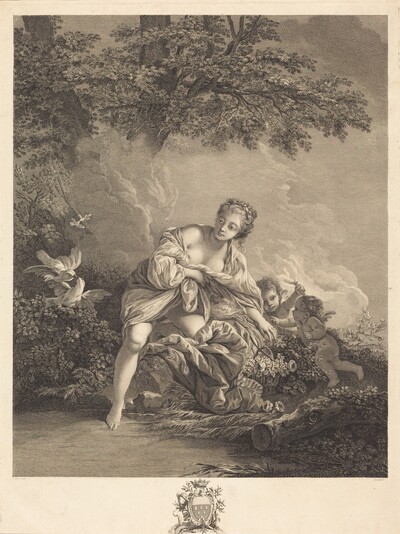
François Boucher's The Bath of Venus (1751) epitomizes the Rococo style at its most sensuous and intellectually playful. The painting depicts Venus, goddess of love, at her bath attended by cupids and doves in a landscape deliberately constructed for beauty rather than realism. Boucher, who served as First Painter to King Louis XV and was Madame de Pompadour's favorite artist, created a visual world where mythology served as pretext for the celebration of flesh, fabric, and decorative abundance. The painting's 1751 date places it during the apex of Rococo cultural dominance, when the French aristocracy embraced an aesthetic of pleasure, intimacy, and artful avoidance of serious subjects. Venus at her bath was an ideal subject for this sensibility: mythological enough to claim classical precedent, erotic enough to delight, and decorative enough to suit the elaborate interiors for which it was destined. Boucher's handling is characteristically fluent—smooth, glossy surfaces that deny the physicality of paint in favor of the physicality of skin, silk, and water. His palette favors the pastels—rose, sky blue, ivory—that defined Rococo taste. Yet to dismiss the painting as merely decorative would miss its sophistication: Boucher's composition balances the nude Venus against the landscape with the precision of a mathematician arranging an equation.
Cultural Impact
The Bath of Venus influenced how mythological subjects were treated in 18th-century European art, establishing a model of erotic classicism that spread from France to courts across Europe. Boucher's Rococo Venus became a reference point for all subsequent depictions of the goddess—determining how she was imagined even as Neoclassicism rejected the Rococo style. The painting also influenced interior design: works like this were created as focal points for the elaborate decorative schemes of French hôtel particuliers, influencing how walls, furniture, and paintings were integrated into unified aesthetic environments.
Why It Matters
This painting matters because it represents a complete aesthetic system—the Rococo—at its moment of maximum confidence. It demonstrates that art can create its own world of beauty without reference to moral or philosophical claims. Whether one admires or criticizes this approach, the painting's integrity and assurance demand attention. It also provides a baseline against which the Neoclassical revolt can be measured: every Ingres or David that rejects Boucher does so with full awareness of what is being rejected.