Provenance
El Greco's son, Jorge Manuel Theotocópuli, Toledo, by 1621.[1] possibly in the Convent of San Hermengildo, Madrid, in 1786.[2] Felipe de la Rica of the Montejo family, Madrid, by 1902.[3] Doña Maria de Montejo, Madrid, by 1908.[4] sold after 1926 by the Montejo family to a European art dealer;[5] purchased by (Boehler & Steinmeyer, New York);[6] sold February 1931 to Chester Dale, New York;[7] gift 1943 to NGA.
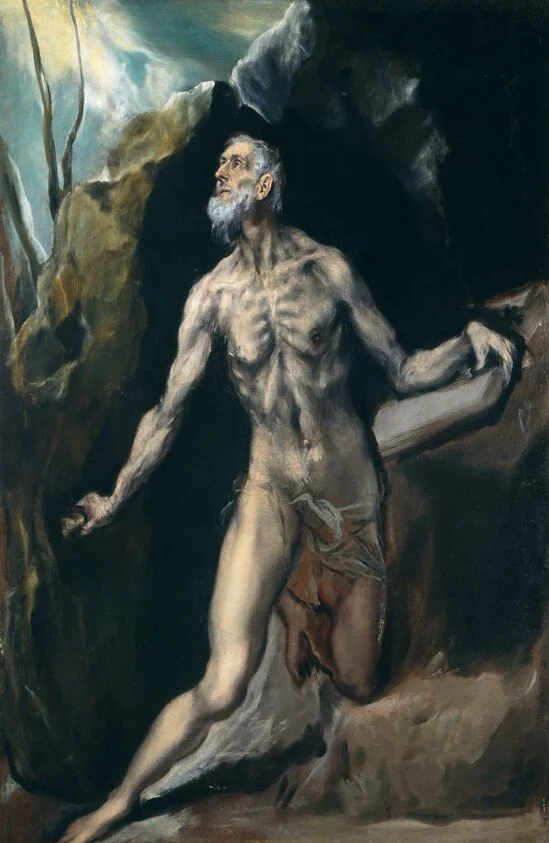
[1] Francisco de Borja de San Román y Fernández, "De la vida del Greco," _Archivo Español de Arte y Arqueologia_ 3 (1927): 82, no. 145: "un San Jerónimo desnudo" ("a nude Saint Jerome"). According to this inventory, the painting measured 2 x 1-1/4 _varas_ (approximately 168 x 106 cm). The present painting is not mentioned by name in the inventory made of the artist's estate in 1614; however, since it was in the possession of El Greco's son in 1621, it seems likely that this painting was one of the "quinze quadros bosquejados" ("fifteen paintings sketched in") mentioned in the inventory of 1614. Francisco de Borja de San Román y Fernández, _El Greco of Toledo_ (Madrid, 1910): 195.
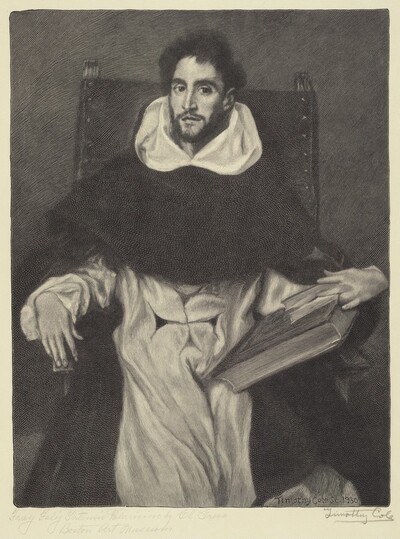
[2] The inventory made of the paintings in the convent included a Saint Jerome by El Greco. See El Conde de Polentinos, "El Convento de San Hermengildo, de Madrid," _Boletín de la Sociedad Esoabika de Excursiones_ 41 (1933): 50. According to this inventory, the painting measured "2 varas y media de alto y ancho" ("2-1/2 varas in height and width"). This indicates that the painting was square. However, because the inventory was inaccurate and inconsistent in many places, it is possible that the compilers of the inventory omitted the width and that they intended to refer to the NGA painting, which was 215 cm tall before the added pieces were removed (Peter Murray, letter, 4 May 1964; and Philip Troutman, letter, 28 May 1964; both in the NGA curatorial files). The unfinished state of the painting may account for the relatively low valuation of 600 _reales_ assigned it in the 1786 inventory. For comparison, El Greco's finished portrait of Fray Hortensio Félix Paravicino (now in the MFA, Boston) was valued at 6000 _reales_ in the same inventory.
[3] Salvador Viniegra, _Catálogo ilustrado de la exposición de las obras de Domenico Theotocópuli, llamado El Greco_ [exh. cat.], 1902, 27, no. 43. A 10 April 1931 letter from Boehler & Steinmeyer quoted in the painting's entry in the Chester Dale notebook, NGA curatorial files, says that Rica was a member of the Montejo family.
[4] Manuel B. Cossío, _El Greco_ (Madrid, 1908): 571, no. 113.
[5] August L. Mayer, _Domenico Theotocopuli, El Greco_. (Munich, 1926): 45, no. 281, repro. 45; 10 April 1931 letter from Boehler & Steinmeyer quoted in the Chester Dale notebook, NGA curatorial files.
[6] 10 April 1931 letter from Boehler & Steinmeyer quoted in the Chester Dale notebook, NGA curatorial files.
[7] 25 February 1931 letter statement of authenticity to Chester Dale from Boehler & Steinmeyer, NGA curatorial files.
Accession Number
1943.7.6
Medium
oil on canvas
Dimensions
overall: 168 x 110.5 cm (66 1/8 x 43 1/2 in.) | framed: 194.3 x 137.2 x 6.4 cm (76 1/2 x 54 x 2 1/2 in.)
Classification
Painting
Credit Line
Chester Dale Collection
Tags
Painting Baroque (1600–1750) Oil Painting Canvas Greek
Background & Context
Background Story
Saint Jerome, painted between 1610 and 1614, depicts the Church Father who translated the Bible into Latin, seated in his study in the act of writing. Jerome was one of the most frequently depicted saints in Counter-Reformation Spain, where his scholarly devotion embodied the Church's intellectual response to Protestantism.
El Greco painted several versions of Saint Jerome throughout his career, but this late work, executed in the final years of his life, is among the most psychologically intense. The saint's gaunt face, his deep-set eyes burning with the fever of intellectual passion, and his hand clutching a pen above the page all convey the urgency of a mind engaged in a task of cosmic significance.
The painting's chromatic scheme is characteristically extreme: Jerome's red cardinal's robe blazes against a background of dark greens and browns, while the face, modeled in gray-green flesh tones, seems to emit its own pale light. The spatial setting, typical of El Greco's late work, is compressed and disorienting - the walls of the study seem to close in around the saint, as though the physical world were shrinking under the pressure of his spiritual vision.
Cultural Impact
El Greco's late religious paintings, with their extreme emotional intensity and non-naturalistic style, anticipated the Expressionist movement by three centuries. Picasso, who studied El Greco's work obsessively during his Blue Period, recognized him as a precursor of modern art's freedom from the tyranny of appearances.
Why It Matters
Saint Jerome captures El Greco at his most extreme and most eloquent - the moment when his art has shed every conventional accommodation and speaks in a voice unlike any other in Western painting. The painting is both a devotional image and a manifesto of artistic independence.