Masters of Their Craft
Artists
Discover the visionaries who shaped the course of art history.
31,194 artists in the collection
Cheng Zhengkui
Chinese
1604 - 1676
Chéng Zhèngkuí (Ch'eng Cheng-k'ui, traditional: 程正揆, simplified: 程正揆); ca. 1604-1670 was a Chinese landscape painter and poet during the Qing Dynasty (1644–1912). Cheng was born in Xiaogan in the Hubei province. His style name was 'Ruibo' and his sobriquets were 'Jiuling and Qingxi daoren'. Cheng was taught by Dong Qichang and collaborated with Kun Can. His landscapes were painted using the side of the dry brush, in a pure and profound style. In poetry he produced the work Qing Xi Left Script.
Chen Hanwen
Chinese

Chen Hongshou
Chinese
Chen Hongshou (1598 Zhuji, Zhejiang province –1652), formerly romanized as Ch'en Hung-shou, was a Chinese painter of the late Ming dynasty.
Chen Jiayan

Chen Jiru
Chinese
1558 - 1639
Chen Jiru (simplified Chinese: 陈继儒; traditional Chinese: 陳繼儒; pinyin: Chén Jìrú; Wade–Giles: Ch'en Chi-ju; 1558–1639) was a Chinese landscape painter, calligrapher and essayist during the Ming dynasty (1368–1644). Chen was born in Huating (华亭; present-day Songjiang District, Shanghai). His courtesy name was Zhongchun (仲醇) and his pseudonyms were Migong (麋公) and Meigong (眉公). Chen's calligraphy followed the style of Su Shi and Mi Fu. Chen also painted landscapes and elegant still lifes. In 1595, he wrote Tea Talks (茶董補), still often quoted in China and Japan, and he studied pottery and created purple clay teapots in the Yixing style. His Shallow Comments on the Art of Nourishing Life as well as A Gentleman's Remarks on Diet were a reference for many years. He was a notable author of the xiaopin, a form of short literary essay. Chen Jiru left an autobiography which contains a "patently fictitious account of the circumstances of his own death, a most extraordinary innovation," writes the modern scholar Pei-yi Wu, describing Chen as "a member of the literati known for his versatile artistic talents." In 2007, Jamie Greenbaum, a researcher at the University of Beijing, published a book on...
Chen Juzhong
Chinese
1201 - 1207
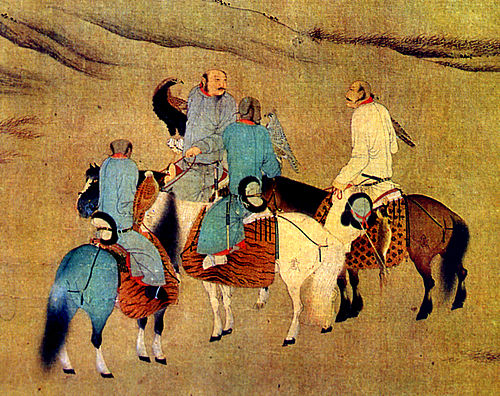
The Khitan people (Khitan small script: ; Chinese: 契丹; pinyin: Qìdān) were a historical nomadic people from East Asia and parts of North Asia who, from the 4th century, inhabited an area corresponding to parts of modern Mongolia, Northeast China and the Russian Far East. As a people descended from the proto-Mongols through the Xianbei, Khitans spoke the now-extinct Khitan language, a Para-Mongolic language related to the Mongolic languages. The Khitan people founded and led the Liao dynasty (916–1125), which dominated a vast area of Siberia, Mongolia and Northern China. The Khitans of the Liao dynasty used two independent writing systems for their language: Khitan small script and Khitan large script. After the fall of the Liao dynasty in 1125 following the Jurchen invasion, many Khitans followed Yelü Dashi's group westward to establish the Qara Khitai or Western Liao dynasty, in Central Asia, which lasted nearly a century before falling to the Mongol Empire in 1218. Other regimes founded by the Khitans included the Northern Liao, Eastern Liao and Later Liao in China, as well as the Qutlugh-Khanid dynasty in Persia. The modern-day Daur people, a recognized minority ethnic group in Northeast...
Chen Mingyuan
Chenoweth, Mary A.
American
American, 1918 - 1999
Chen Qi
Chen Ruyan
Chen Ruyan
Chinese
1331 - 1371
Chen Sijia