Masters of Their Craft
Artists
Discover the visionaries who shaped the course of art history.
31,194 artists in the collection
Dus, Laszlo
American
American, born 1941
László Dús (born 14 July 1941, Zalaegerszeg) is an Americanized Hungarian-born visual artist. Dús is known for nonobjective Modernist prints. Several of his prints are in the permanent collections of the U.S. National Gallery of Art. Dús prints are also in the collections of the Renwick Gallery and the Smithsonian American Art Museum. Dús prints are also in the collection of the Utah Museum of Fine Arts. Typical subject matter is a blocky geometric color field composition with some shapes having "torn" edges. Large-size prints are scarce. Park West Gallery leader Albert Scaglione (also specializing in Pablo Picasso and Pierre-Auguste Renoir), was a major booster of the artist.
Dutch

Dutch 16th Century
Dutch
The 16th century begins with the Julian year 1501 (MDI) and ends with either the Julian or the Gregorian year 1600 (MDC) (depending on the reckoning used; the Gregorian calendar introduced a lapse of 10 days in October 1582). The Habsburg Spanish Empire, Portuguese Empire, Ottoman Empire, Safavid Persia, Mughal India and Ming China were the most powerful and hegemonic states. The Renaissance in Italy and Europe saw the emergence of important artists, authors and scientists, and led to the foundation of important subjects which include accounting and political science. Copernicus proposed the heliocentric universe, which was met with strong resistance, and Tycho Brahe refuted the theory of celestial spheres through observational measurement of the 1572 appearance of a Milky Way supernova. These events directly challenged the long-held notion of an immutable universe supported by Ptolemy and Aristotle, and led to major revolutions in astronomy and science. Galileo Galilei became a champion of the new sciences, invented the first thermometer and made substantial contributions in the fields of physics and astronomy, becoming a major figure in the Scientific Revolution in Europe. Spain...

Dutch 17th Century
Dutch
The 17th century lasted from January 1, 1601 (represented by the Roman numerals MDCI), to December 31, 1700 (MDCC). It falls into the early modern period of Europe and in that continent (whose impact on the world was increasing) was characterized by the Baroque cultural movement, the latter part of the Spanish Golden Age, the Dutch Golden Age, the French Grand Siècle dominated by Louis XIV, the Scientific Revolution, the world's first public company and megacorporation known as the Dutch East India Company, and according to some historians, the General Crisis. From the mid-17th century, European politics were increasingly dominated by the Kingdom of France of Louis XIV, where royal power was solidified domestically in the civil war of the Fronde. The semi-feudal territorial French nobility was weakened and subjugated to the power of an absolute monarchy through the reinvention of the Palace of Versailles from a hunting lodge to a gilded prison, in which a greatly expanded royal court could be more easily kept under surveillance. With domestic peace assured, Louis XIV caused the borders of France to be expanded. It was during this century that the English monarch became increasingly...
Dutch 18th Century
Dutch
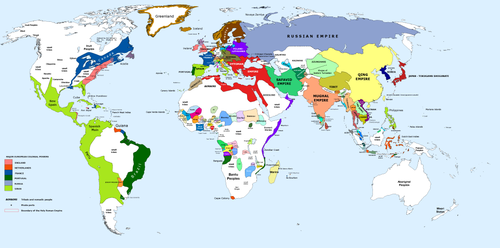
The 18th century lasted from 1 January 1701 (represented by the Roman numerals MDCCI) to 31 December 1800 (MDCCC). During the 18th century, elements of Enlightenment thinking culminated in the Atlantic Revolutions. Revolutions began to challenge the legitimacy of monarchical and aristocratic power structures. The Industrial Revolution began mid-century, leading to radical changes in human society and the environment. The European colonization of the Americas and other parts of the world intensified and associated mass migrations of people grew in size as part of the Age of Sail. During the century, slave trading expanded across the shores of the Atlantic Ocean, while declining in Russia and China. Western historians have occasionally defined the 18th century otherwise for the purposes of their work. For example, the "short" 18th century may be defined as 1715–1789, denoting the period of time between the death of Louis XIV of France and the start of the French Revolution, with an emphasis on directly interconnected events. To historians who expand the century to include larger historical movements, the "long" 18th century may run from the Glorious Revolution of 1688 to the Battle of...
Dutch 19th Century
Dutch
After the last years of the 18th century, which had seen the decline of the Dutch Republic, including the arts and international politics, the 19th-century was marked by a general revival of intellectual force. The romantic movement in Germany made itself deeply felt in all branches of Dutch literature and German lyricism took the place hitherto held by French classicism, in spite of the country falling to French expansionism, during the Batavian revolution.
Dutes Miller and Stan Shellabarger

Dutka, Agnieszka
Polish
Polish, born 1959
On March 21, 1890, at a conference dedicated to the siege of Bilbao during the Third Carlist War, Miguel de Unamuno delivered a lecture titled La última guerra carlista como materia poética. It was probably the first-ever attempt to examine the Carlist motive in literature, as for the previous 57 years the subject had been increasingly present in poetry, drama and novel. However, it remains paradoxical that when Unamuno was offering his analysis, the period of great Carlist role in letters was just about to begin. It lasted for some quarter of a century, as until the late 1910s Carlism remained a key theme of numerous monumental works of Spanish literature. Afterward, it lost its appeal as a literary motive, still later reduced to instrumental role during Francoism. Today it enjoys some popularity, though no longer as catalyst of paramount cultural or political discourse; its role is mostly to provide exotic, historical, romantic, and sometimes mysterious setting.
Dutterer, William
American
American, 1943 - 2007
William S. Dutterer (1943–2007) was a Washington artist who moved to New York City in 1979 and continued making innovative work until his death in January 2007. Over his 40+ year career, Dutterer developed his own idiosyncratic visual vocabulary that often referenced masks (or, interchangeably, the face), wrapped objects (a mummy or a bound head), the idea of exploring the depths, and the concept of the bystander (a witness so close as to be a possible victim of irrational acts) from his minimalist work of the '60s. His work engages the viewer, encouraging us to consider how our culture and world events impact the way we see ourselves and allow others to see us.
Dutton, Allen
American
American, 1922 - 2017

Duval-Carrie, Edouard
American
American, born Haiti, 1954
Edouard Duval-Carrié (born 1954) is a Haitian-born American contemporary painter and sculptor based in Miami, Florida.
Duval, Marc
French
French, 1530 - 1581