Masters of Their Craft
Artists
Discover the visionaries who shaped the course of art history.
31,194 artists in the collection
Francesco da Urbino
Francesco de Mura

Francesco di Giorgio Martini
Italian
Sienese, 1439 - 1501
Francesco di Giorgio Martini (1439–1501) was an Italian architect, engineer, painter, sculptor, and writer. As a painter, he belonged to the Sienese School. He was considered a visionary architectural theorist—in Nikolaus Pevsner's terms: "one of the most interesting later Quattrocento architects". As a military engineer, he executed architectural designs and sculptural projects and built almost seventy fortifications for the Federico da Montefeltro, Count (later Duke) of Urbino, building city walls and early examples of star-shaped fortifications. Born in Siena, he apprenticed as a painter with Vecchietta. In panels painted for cassoni he departed from the traditional representations of joyful wedding processions in frieze-like formulas to express visions of ideal, symmetrical, vast and all but empty urban spaces rendered in perspective. He composed an architectural treatise Trattato di architettura, ingegneria e arte militare, the third of the Quattrocento, after Leone Battista Alberti's and Filarete's; he worked on it for decades and finished sometime after 1482; it circulated in manuscript. The treatise was included in several original manuscripts with one copy (i.e., Codex Mediceo...
Francesco di Giorgio Martini
Italian
1439 - 1501
Francesco di Giorgio Martini (1439–1501) was an Italian architect, engineer, painter, sculptor, and writer. As a painter, he belonged to the Sienese School. He was considered a visionary architectural theorist—in Nikolaus Pevsner's terms: "one of the most interesting later Quattrocento architects". As a military engineer, he executed architectural designs and sculptural projects and built almost seventy fortifications for the Federico da Montefeltro, Count (later Duke) of Urbino, building city walls and early examples of star-shaped fortifications. Born in Siena, he apprenticed as a painter with Vecchietta. In panels painted for cassoni he departed from the traditional representations of joyful wedding processions in frieze-like formulas to express visions of ideal, symmetrical, vast and all but empty urban spaces rendered in perspective. He composed an architectural treatise Trattato di architettura, ingegneria e arte militare, the third of the Quattrocento, after Leone Battista Alberti's and Filarete's; he worked on it for decades and finished sometime after 1482; it circulated in manuscript. The treatise was included in several original manuscripts with one copy (i.e., Codex Mediceo...
Francesco Durantino
Francesco Fanelli
Francesco Fanelli
Italian
Francesco Fontebasso

Francesco Francia
Portrait of Federico II Gonzaga (also called Portrait of Federigo Gonzaga) is a Renaissance portrait of a young boy by Francesco Francia in the Metropolitan Museum of Art in New York. The painter as author, the year 1510 and Federico II Gonzaga (portrayed at the age of 10) are considered to be sure, since conforming information is documented by numerous letters.
Francesco Furini
Francesco Furini
Italian
1603 - 1646
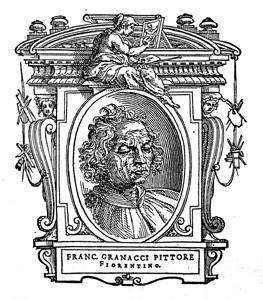
Francesco Granacci
Italian
1469 - 1543
Francesco Granacci (1469 – 30 November 1543) was an Italian Renaissance painter active primarily in his native Florence. Though little-known today, he was regarded in his time and is featured in Giorgio Vasari's Lives of the Artists. Granacci was born in 1469 in Villamagna, and was trained in Florence in the workshop of Domenico Ghirlandaio, where he became lifelong friends with Michelangelo. The two frequented Lorenzo de' Medici's famous sculpture garden near the convent of San Marco. His earliest works, such as the Madonna and Child with Saints Michael and John the Baptist (Staatliche Museen, Berlin), Adoration of the Child (Honolulu Museum of Art) and his panel from the four histories of Saint John the Baptist (Metropolitan Museum of Art, New York) show the strong influence of Ghirlandaio as well as Filippino Lippi, who might have been Granacci's first master. According to Vasari, when Granacci was still a youth he modeled for the nude figure in Filippino's Raising of Theophilus in the Brancacci Chapel. In 1508 Granacci went to Rome, where he and other artists, including Agnolo di Domenico del Mazziere, were asked to help Michelangelo with the Sistine Chapel ceiling. On his return...