Provenance
Recorded as from the Hudson River Valley, New York. Purchased in 1949 by Edgar William and Bernice Chrysler Garbisch; gift to NGA, 1956.
Accession Number
1956.13.2
Medium
oil on canvas
Dimensions
overall: 45.7 x 61 cm (18 x 24 in.) | framed: 55.8 x 71.1 x 5 cm (21 15/16 x 28 x 1 15/16 in.)
Classification
Painting
Credit Line
Gift of Edgar William and Bernice Chrysler Garbisch
Tags
Painting Neoclassical & Romantic (1751–1850) Oil Painting Canvas American
Background & Context
Background Story
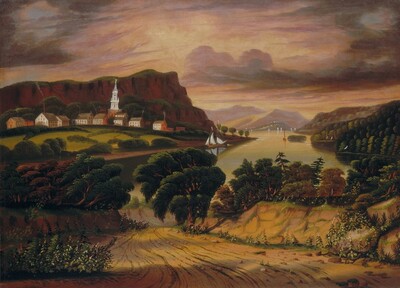
The Connecticut Valley (c. 1840-1850) depicts the river valley that forms one of New England's most distinctive landscapes—the long, wide valley that the Connecticut River has carved through the mountainous terrain of Vermont, New Hampshire, and Massachusetts. Chambers's treatment of the Connecticut Valley combines American landscape painting's topographic tradition with the decorative boldness that distinguishes his work. The valley, with its flat floor, its enclosing hills, and the river winding through agricultural land, provided Chambers with a landscape subject that was both geographically specific and compositionally striking. The Connecticut Valley was one of the most agricultural regions in New England, and Chambers's depiction likely includes the farms, fields, and settlements that made the valley productive as well as scenic. The 1840-50 date places this during the period when the Connecticut Valley was being transformed by industrialization—textile mills were appearing along the river, and the agricultural landscape that Chambers depicts was beginning to change. The painting thus documents the valley at a transitional moment—still predominantly agricultural but beginning to feel the industrial transformation that would reshape New England's economy and landscape.
Cultural Impact
Chambers's landscape paintings influenced how New England's river valleys were represented in American art, establishing the Connecticut Valley as a significant landscape subject. The paintings influenced later American artists who similarly found subjects in river valley landscapes. The Connecticut Valley painting influenced how the agricultural landscape of New England was documented at the moment before industrialization transformed it.
Why It Matters
This painting matters because it captures the Connecticut Valley at a transitional moment—still the agricultural landscape that had sustained New England for two centuries, but beginning to feel the industrial transformation that would reshape the region's economy and appearance. Chambers's bold treatment gives the valley the visual intensity that more conventional landscape painting often lacked.