Provenance
Recorded as from Boston. Purchased in 1949 by Edgar William and Bernice Chrysler Garbisch; gift to NGA, 1958.
Accession Number
1958.5.1
Medium
oil on canvas
Dimensions
overall: 35.6 x 46 cm (14 x 18 1/8 in.) | framed: 44.6 x 54.4 x 3.3 cm (17 9/16 x 21 7/16 x 1 5/16 in.)
Classification
Painting
Credit Line
Gift of Edgar William and Bernice Chrysler Garbisch
Tags
Painting Neoclassical & Romantic (1751–1850) Oil Painting Canvas American
Background & Context
Background Story
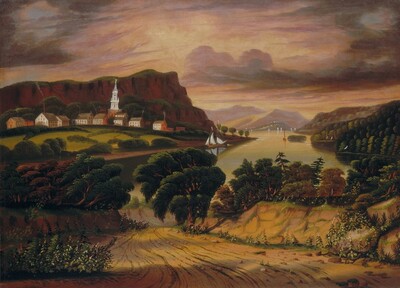
Mount Auburn Cemetery (c. 1845-1855) depicts America's first rural cemetery—founded in 1831 in Cambridge, Massachusetts, as a response to the overcrowded and unsanitary urban burial grounds that had characterized American practice. Mount Auburn was a revolutionary concept: a designed landscape where the dead could be buried in a beautiful natural setting, combining the functions of cemetery and public garden. The cemetery's design—influenced by English landscape gardening and by the European tradition of the Picturesque—created winding paths, scenic vistas, and planted woodlands that made it one of the most visited public spaces in New England. Chambers's treatment of Mount Auburn likely emphasizes the Picturesque qualities that made the cemetery so popular: the varied terrain, the planted trees and shrubs, the monuments and tombs that punctuated the landscape, and the specific atmosphere of melancholy beauty that rural cemeteries cultivated. The 1845-55 date places this during the period when the rural cemetery movement was at its most influential—Mount Auburn had spawned imitators across America, and the garden-cemetery concept was transforming American attitudes toward death, mourning, and public space. The painting documents a significant chapter in American landscape design: the moment when the Picturesque aesthetic was applied to the most fundamental of human needs.
Cultural Impact
Chambers's Mount Auburn painting influenced how the American rural cemetery movement was represented in art, documenting the landscape-design revolution that transformed American attitudes toward death and public space. The painting influenced later American artists who similarly found subjects in designed landscapes. The cemetery subject influenced how the Picturesque was applied to American landscapes, connecting European landscape theory to American practice.
Why It Matters
This painting matters because it documents America's first rural cemetery—the landscape-design innovation that transformed American attitudes toward death, mourning, and public space—and does so with the artistic attention that Mount Auburn's founders intended when they created a space where nature and memory could coexist.