Provenance
Painted for Sir William Maynard, 4th bt. [1721-1772], Waltons, Ashdon, Essex; by descent to Frances, Countess of Warwick,[1] who offered it as property of the Maynard Collection at (sale, Sotheby's, London, 21 November 1934, no. 34, bought in); offered again, as property of the late Frances, Countess of Warwick, and of the Hon. Maynard and Mrs. Greville at (sale, Christie, Manson & Woods, London, 28 May 1948, no. 25), bought by Hemming. Walter Hutchinson, London; (sale, Christie, Manson & Woods, London, 20 July 1951, no. 87, bought in); (sale, Christie, Manson & Woods, London, 7 October 1955, no. 24); purchased by (Betts) for (Montague Bernard), who sold it to (Ackermann), from whom it was purchased 1960 by Paul Mellon, Upperville, Virginia; gift 1964 to NGA.
[1] She was the elder daughter and co-heir of Col. the Hon. Charles Henry Maynard, son of the 3rd and last Viscount Maynard [1786-1865].
Accession Number
1964.2.4
Medium
oil on canvas
Dimensions
overall: 138.5 x 195.6 cm (54 1/2 x 77 in.) | framed: 158.8 x 217.2 x 7 cm (62 1/2 x 85 1/2 x 2 3/4 in.)
Classification
Painting
Credit Line
Paul Mellon Collection
Tags
Painting Neoclassical & Romantic (1751–1850) Oil Painting Canvas British
Background & Context
Background Story
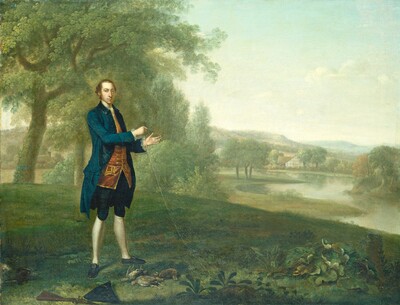
Arthur Devis's "Members of the Maynard Family in the Park at Waltons" (c. 1755/1762) is a quintessential example of the English conversation piece — a genre of small-scale group portrait that flourished in eighteenth-century Britain, depicting families and friends in informal, often outdoor settings that showcased their estates, their manners, and their social position. The painting shows the Maynard family arranged on the grounds of their country house, engaged in the leisurely pursuits — walking, conversing, admiring the view — that defined the rural life of the English landed gentry.
Devis (1712–1787) was the most prolific and characteristic painter of conversation pieces in mid-eighteenth-century England, producing hundreds of these small-scale domestic group portraits over a career spanning four decades. His paintings are immediately recognizable by their distinctive style: small, stiffly posed figures arranged in carefully composed landscapes or interiors, rendered with a precise, almost naive technique that gives them a charming, doll-like quality. Devis's figures rarely interact with the natural spontaneity of real conversation; instead, they pose in attitudes of refined leisure, each turned slightly toward the viewer, as if aware of being observed.
The Maynard family shown in this painting were members of the Essex gentry, and Waltons was their country estate. The painting served a dual function: as a portrait record of the family members and as a celebration of their property and social status. The estate itself — its manicured grounds, grand house, and productive farmland — is as much the subject of the painting as the people who inhabit it. The landscape is rendered with the same meticulous care as the figures, each tree and building clearly delineated in a manner that emphasizes ownership and possession.
The conversation piece genre emerged in the early eighteenth century as a specifically English form of portraiture, distinct from the grand manner portraits that dominated Continental European art. Where a Van Dyck or a Rigaud portrayed individual sitters with heroic grandeur, the conversation piece portrayed groups of people in settings that defined their social world. The genre reflected the values of a society that prized property, gentility, and the harmonious integration of family life with the rural landscape — the values that would later be celebrated in Jane Austen's novels and mocked in William Hogarth's satires.
Devis's work has enjoyed renewed appreciation in recent decades as scholars have recognized its value as a document of eighteenth-century social life, dress, architecture, and landscape design, as well as its distinctive charm as a form of vernacular art.
Cultural Impact
Devis's conversation pieces provide an invaluable visual record of eighteenth-century English gentry life — their dress, manners, homes, and landscapes — while embodying a genre of domestic portraiture that was uniquely English in its emphasis on property, family, and social position.
Why It Matters
This painting exemplifies the English conversation piece at its most characteristic — a family portrait that is simultaneously a record of people, a celebration of property, and a document of the rural gentry life that defined eighteenth-century English identity.