Provenance
Recorded as from New York. Private collection, Boston; sold by October 1965 to (Hirschl and Adler Galleries, New York), by whom sold in 1965 to Edgar William and Bernice Chrysler Garbisch; gift to NGA, 1969.
Accession Number
1969.11.1
Medium
oil on canvas
Dimensions
overall: 54.4 x 77.2 cm (21 7/16 x 30 3/8 in.) | framed: 66 x 87.6 x 5.7 cm (26 x 34 1/2 x 2 1/4 in.)
Classification
Painting
Credit Line
Gift of Edgar William and Bernice Chrysler Garbisch
Tags
Painting Neoclassical & Romantic (1751–1850) Oil Painting Canvas American
Background & Context
Background Story
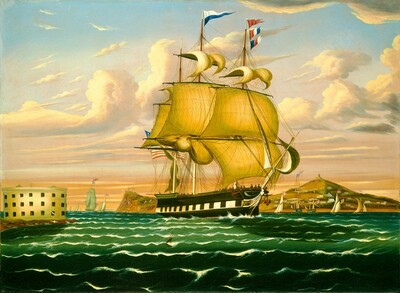
Storm-Tossed Frigate (c. 1840-1850) represents Chambers's engagement with the marine-painting tradition of the ship in storm—one of the most dramatic subjects in European and American marine art. The frigate, a warship type that combined speed with firepower, was one of the most visually impressive vessels of the age of sail, and its confrontation with storm conditions provided the marine painter with the most dramatic subject available. Chambers's treatment of the storm-tossed vessel demonstrates his ability to render both the vessel's specific architecture and the sea's dramatic power—the frigate's hull, rigging, and the specific way it responds to wave action are rendered with the marine painter's observational precision, while the storm's atmospheric violence provides the dramatic context. The painting also reflects the 19th-century marine painting tradition's engagement with the sublime: the storm's power exceeds human control, and the frigate—despite its military capability—is at the sea's mercy. This confrontation between human technology and natural force was one of marine painting's most philosophical subjects, and Chambers's bold palette—the dramatic contrast between dark storm clouds, breaking seas, and the frigate's pale sails—gives the subject a visual intensity that matches its philosophical depth.
Cultural Impact
Chambers's storm paintings influenced how the marine sublime was represented in American art, connecting the European tradition of the ship in storm to American marine painting. The paintings influenced later American marine painters who similarly found subjects in the confrontation between vessels and natural forces. The storm-tossed frigate influenced how naval vulnerability was represented during the age of sail.
Why It Matters
This painting matters because it represents the marine sublime at its most dramatic—the warship confronting storm conditions that exceed its capability—rendered with the bold palette and decorative intensity that make Chambers's work unique in American marine painting. The frigate's vulnerability in the storm argues for the sublime dimension of marine experience that more tranquil harbor views sometimes conceal.