Provenance
Art market, Paris;[1] (Galerie J. Fischer - Ch. Kiener, Paris); sold November 1991 to Mrs. John Jay Ide, San Francisco; gift 1994 to NGA.
[1] See letter dated 28 October 1999 from Jacques Fischer, in NGA curatorial files.
Accession Number
1994.52.3
Medium
oil on paper
Dimensions
overall: 29 x 44 cm (11 7/16 x 17 5/16 in.) | framed: 42.2 x 59.4 x 5.4 cm (16 5/8 x 23 3/8 x 2 1/8 in.)
Classification
Painting
Credit Line
Gift of Mrs. John Jay Ide in memory of Mr. and Mrs. William Henry Donner
Tags
Painting Neoclassical & Romantic (1751–1850) Oil Painting French
Background & Context
Background Story
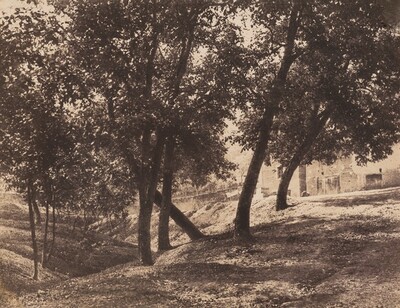
André Giroux (1801-1879) was a French painter who won the Prix de Rome for historical landscape and spent formative years in Italy painting the Roman Campagna and its surroundings. Forest Interior with a Painter, Civita Castellana from 1825-30 depicts a forest scene near the hill town of Civita Castellana, north of Rome, with a painter visible within the landscape—a self-reflexive device that draws attention to the act of painting itself. The oil on paper format was favored by landscape painters working on site because it allowed rapid execution and easy transport, and the painting's fresh handling suggests the direct observation that plein-air painting demanded.
Cultural Impact
Giroux's Italian landscape paintings participate in the tradition of the paysage historique (historical landscape) that dominated French landscape painting in the early 19th century, but their fresh handling and direct observation anticipate the Barbizon School's more naturalistic approach. The forest interior at Civita Castellana combines the compositional principles of the paysage historique with the on-site observation that would become the hallmark of French landscape painting in the 1830s and 1840s.
Why It Matters
Forest Interior with a Painter, Civita Castellana is Giroux between academic landscape and plein-air observation: the compositional principles of the paysage historique combined with the fresh handling of on-site painting. The oil on paper format and the painter within the landscape make this a self-reflexive image—landscape painting about landscape painting.