Provenance
Art market, Paris;[1] (Galerie J. Fischer - Ch. Kiener, Paris); sold November 1991 to Mrs. John Jay Ide, San Francisco; gift 1994 to NGA.
[1] See letter dated 28 October 1999 from Jacques Fischer, in NGA curatorial files.
Accession Number
1994.52.4
Medium
oil on paper
Dimensions
overall: 29.5 x 44.5 cm (11 5/8 x 17 1/2 in.) | framed: 42.6 x 57.5 x 5.6 cm (16 3/4 x 22 5/8 x 2 3/16 in.)
Classification
Painting
Credit Line
Gift of Mrs. John Jay Ide in memory of Mr. and Mrs. William Henry Donner
Tags
Painting Neoclassical & Romantic (1751–1850) Oil Painting French
Background & Context
Background Story
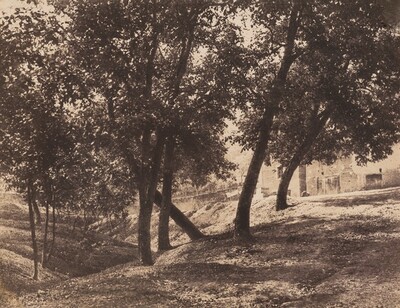
Forest Interior with a Waterfall, Papigno from 1825-30 is a companion piece to the Civita Castellana forest interior, depicting another forest scene near the village of Papigno in the Roman Campagna. The waterfall provides a focal point for a composition that combines the vertical emphasis of the falling water with the horizontal recession of the forest interior—a compositional challenge that Giroux solves by balancing the two movements against each other. The oil on paper format allows the rapid handling and fresh color that distinguish his Italian landscapes from the more finished canvases of his Salon submissions.
Cultural Impact
Giroux's waterfall scene at Papigno is one of the most accomplished French landscape paintings of the 1820s because it combines the structural rigor of the academic landscape tradition with the fresh observation of on-site painting. The waterfall—a classic paysage historique subject—is rendered with the kind of direct observation that anticipates the Barbizon School's more naturalistic approach to landscape painting.
Why It Matters
Forest Interior with a Waterfall, Papigno is Giroux's academic structure meeting plein-air freshness: a waterfall and forest interior composed with paysage historique rigor but painted with the direct observation of on-site work. The oil on paper format preserves the freshness that a more finished canvas would have lost.