Provenance
The artist; (his sale, by Robert Somerville, Fifth Avenue Art Galleries, New York, 26-27 January 1892, 1st day, no. 5); Thomas B. Clarke [1848-1931], New York; (his sale, American Art Galleries, 14-17 February 1899, no. 20); A. Steckler. (sale, O'Reilly's Plaza Art Galleries, New York).[1] (John Levy Galleries, New York), in 1944.[2] private collection; by descent to consignor to 2009 sale; (sale, Christie, Manson & Woods, New York, 5 March 2009, no. 138); purchased by the Corcoran Gallery of Art, Washington; acquired 2015 by the National Gallery of Art.
[1] This information is from a label on the back of the frame. The painting has not yet been identified in an O'Reilly auction.
[2] The painting was included in an exhibition at the Levy Galleries; no owners were identified in the exhibition checklist.
Accession Number
2015.19.238
Medium
oil on canvas
Dimensions
overall: 30.48 × 45.72 cm (12 × 18 in.) | framed: 46.99 × 60.33 × 6.99 cm (18 1/2 × 23 3/4 × 2 3/4 in.)
Classification
Painting
Credit Line
Corcoran Collection (Museum Purchase by exchange: Mr. and Mrs. Ignatius Sargent)
Tags
Painting Neoclassical & Romantic (1751–1850) Oil Painting Canvas American
Background & Context
Background Story
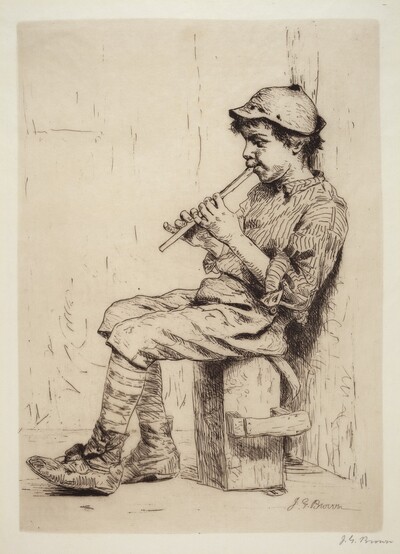
John George Brown's A Longshoreman depicts a working-class figure from the waterfront districts of late 19th-century America. Brown (1831-1913), a British-born painter who emigrated to the United States, became one of the most popular and commercially successful genre painters of the Gilded Age. He is best known for his depictions of street urchins and working-class subjects, rendered with a sentimental charm that appealed enormously to middle-class and upper-class patrons. The longshoreman, a dock worker responsible for loading and unloading ships, stands as a symbol of the manual labor that powered America's commercial expansion. Brown's treatment of the subject likely follows his characteristic approach: a figure rendered with sympathetic attention and technical polish, emphasizing the dignity of labor while softening the harder edges of working-class life. His paintings walked a fine line between social realism and sentimentality, presenting laborers and street children with clean faces and noble bearing that reassured affluent viewers. The waterfront setting connects the work to New York's bustling harbor, the engine of the city's economic growth. Brown served as president of the National Academy of Design and was a leading figure in the New York art establishment. His popularity during his lifetime was immense, though later art historical assessment has been more critical of the sentimental tendencies in his work. This painting represents an important document of how the Gilded Age chose to see its working people.
Cultural Impact
Brown's genre paintings shaped popular perceptions of American working-class life during the Gilded Age. His enormous commercial success reflects how Victorian audiences consumed images of labor through a lens of sentimentality rather than social critique.
Why It Matters
This work illuminates the complex intersection of social observation and commercial sentimentality in Gilded Age American genre painting, revealing how the era chose to represent its laboring class.