Provenance
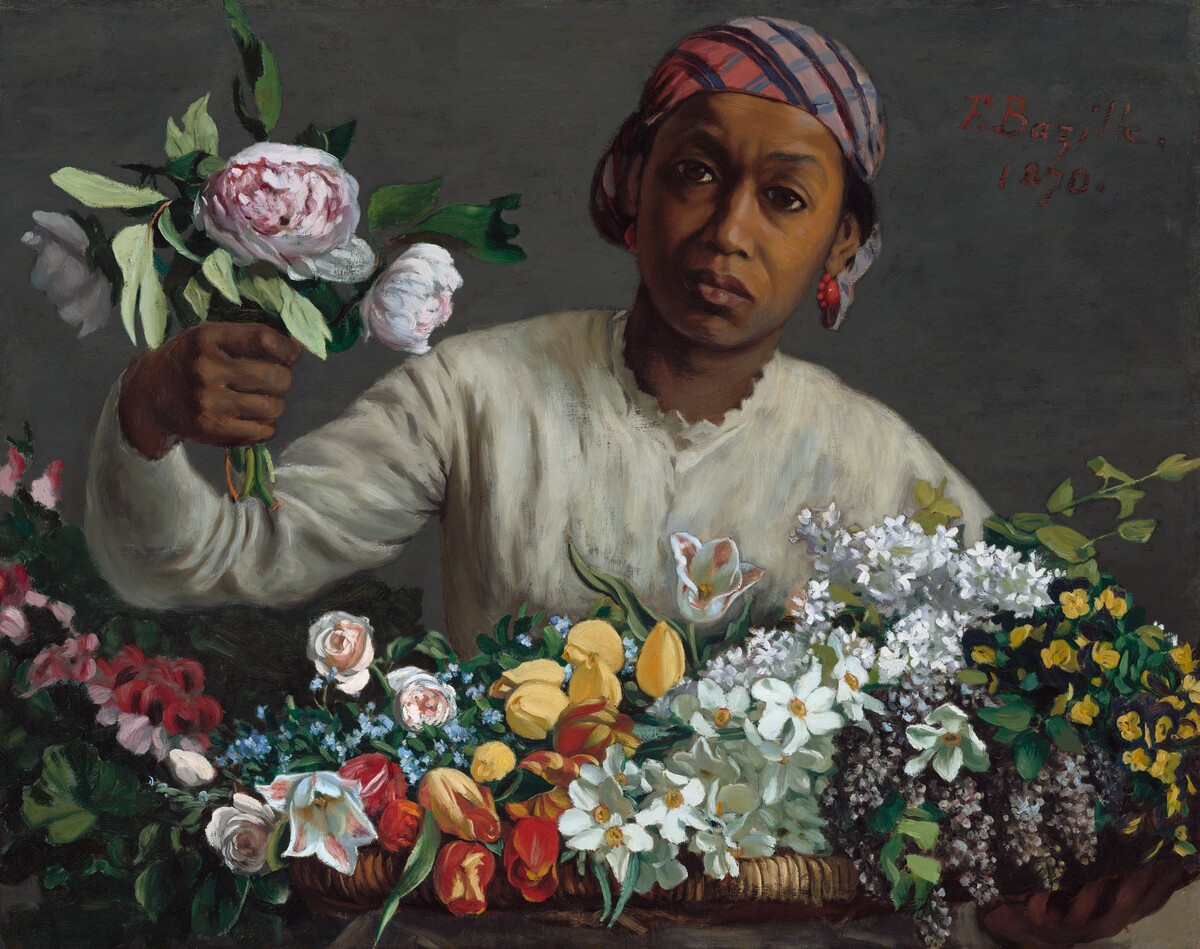
Given by the artist to Edmond Maître [d. 1898]; Gaston Maître; given 1913 to the artist's brother, Marc Bazille;[1] the artist's nephew, Frédéric Bazille, Montpellier, France, by 1935 until at least 1959.[2] (Wildenstein, London, New York, and Paris); sold October 1963 to Paul Mellon, Upperville, VA;[3] gift 1983 to NGA.
[1]See Michel Schulman, _Frédéric Bazille, 1841-1870, catalogue raisonné_, Paris, 1995, no. 61. [2]Lent by Frédéric Bazille to exhibitions in Paris in 1935, and in Montpellier in 1941 and 1959. [3]Acquisition source and date per Paul Mellon records in NGA curatorial files.
Accession Number
1983.1.6
Medium
oil on canvas
Dimensions
overall: 60 x 75 cm (23 5/8 x 29 1/2 in.) | framed: 83.8 x 99.4 x 7.6 cm (33 x 39 1/8 x 3 in.)
Classification
Painting
Credit Line
Collection of Mr. and Mrs. Paul Mellon
Background & Context
Background Story
Beach at Deauville, painted around 1865, is a characteristic work by Eugene Boudin, the painter whom Monet called the king of the skies. The painting depicts the fashionable beach at Deauville, its white sands populated by well-dressed Parisians strolling under parasols, while the vast Norman sky fills three-quarters of the canvas with its towering cloud formations.
Boudin was the first French painter to make the beach resort a serious subject. Working in the 1850s and 1860s - decades before the Impressionists exhibited - he developed a technique of rapid, plein-air painting that would become the foundation of Impressionism. His beach scenes, painted on small panels that could be carried and completed on the spot, capture the effects of light and weather with a directness that anticipates Monet's most radical work.
The painting's true subject is the sky. Boudin's clouds - luminous, voluminous, constantly changing - dominate the composition and determine its mood. The tiny figures below are almost incidental, elements of scale that emphasize the immensity of the atmosphere above them. This attention to sky and weather became Boudin's signature and established the cloud study as a major subject in French painting.
Cultural Impact
Boudin's beach and sky paintings established the plein-air tradition in French painting and directly influenced the development of Impressionism. His demonstration that the transient effects of weather could be captured on the spot created the technical foundation for the Impressionist revolution.
Why It Matters
Beach at Deauville captures Boudin's central contribution: the sky as subject. His Norman clouds, towering above miniature fashionables, demonstrated that the most dramatic landscape in France was the sky itself - a subject that no painter before Boudin had taken seriously enough.