Provenance
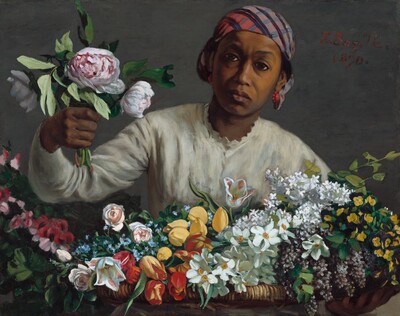
Marc Bazille, brother of the artist; his daughter, Mme Meynier de Salinelles-Bazille, Montpellier, by 1935 until at least 1949.[1] (sale, Palais Galliéra, Paris, 19 June 1963, unnumbered); purchased by (Hector Brame, Paris); sold 1963 to Paul Mellon, Upperville, VA;[2] gift 1985 to NGA.
[1] Lent by Mme Meynier de Salinelles-Bazille exhibitions in Paris in 1935 and to the Royal Academy exhibition in 1949.
[2] Acquisition and source according tp Paul Mellon records in NGA curatorial files.
Accession Number
1985.64.1
Medium
oil on canvas
Dimensions
overall: 60 x 100 cm (23 5/8 x 39 3/8 in.) | framed: 78.7 x 116.2 x 7 cm (31 x 45 3/4 x 2 3/4 in.)
Classification
Painting
Credit Line
Collection of Mr. and Mrs. Paul Mellon
Tags
Painting Impressionist & Modern (1851–1900) Oil Painting Canvas French
Background & Context
Background Story
Frederic Bazille (1841-1870) was a French painter known for his role in the early Impressionist movement and for the figurative paintings that combine the clear light of Impressionism with the solidly modeled figures of the academic tradition. The Western Ramparts at Aigues-Mortes from 1867 depicts the medieval fortifications of Aigues-Mortes in the clear, sunlit manner that distinguishes Bazille's best landscape painting. The 1867 date places this in Bazille's most productive period, when he was producing the landscapes and figurative paintings that make him one of the most promising painters of the early Impressionist group—before his death in the Franco-Prussian War at the age of 28 cut short one of the most promising careers in French painting.
Cultural Impact
The Western Ramparts at Aigues-Mortes is important in the history of Impressionism because it demonstrates the clear, sunlit manner that Bazille brought to landscape subjects—clear light without the atmospheric dissolution of Monet's later Impressionism. Bazille's death at 28 in the Franco-Prussian War deprived French painting of one of its most promising talents, and the 1867 painting shows the clear, solid manner that would have developed into a major career.
Why It Matters
The Western Ramparts at Aigues-Mortes is Bazille's clear Impressionist light: the medieval fortifications rendered in the clear, sunlit manner that distinguishes his landscape painting from Monet's more atmospheric Impressionism. The 1867 painting shows the promise that was cut short by Bazille's death at 28 in the Franco-Prussian War—one of the great losses in French painting.