The Old Guitarist

Description

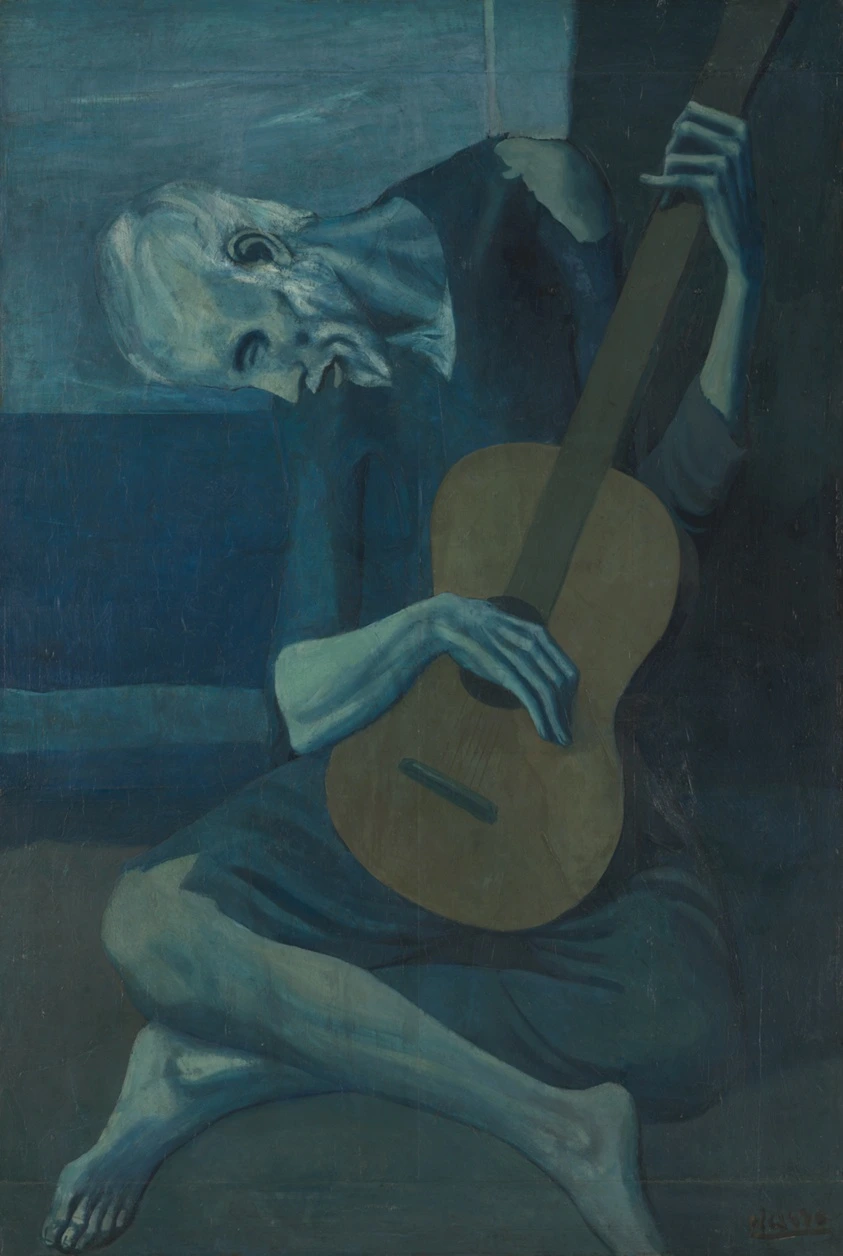
Pablo Picasso made The Old Guitarist while working in Barcelona. In the paintings of his Blue Period (1901-04), the artist restricted himself to a cold, monochromatic blue palette, flattened forms, and emotional, psychological themes of human misery and alienation related to the work of such artists as Edvard Munch and Paul Gauguin. The elongated, angular figure of the blind musician also relates to Picasso's interest in Spanish art and, in particular, the great 16th-century artist El Greco. The image reflects the twenty-two-year-old Picasso's personal struggle and sympathy for the plight of the downtrodden; he knew what it was like to be poor, having been nearly penniless during all of 1902.

Provenance

Ambroise Vollard (1867–1939), Paris, c. 1906, probably acquired directly from the artist [New York 2006]; sold through Carroll Galleries, New York, to John Quinn (1870–1924), New York, 1915 [Feb. 26, 1915 letter from John Quinn to Ambroise Vollard, and Memorandum of Pictures consigned to Carroll Galleries, Inc., John Quinn Collection, New York Public Library Manuscript Division, copies in curatorial object file]; Quinn Estate, 1924; sold through Felix Wildenstein, Art Centre auction, New York, to Paul Rosenberg (1881–1959), Paris, Jan. 9, 1926 [“52 Picasso Paintings Sold,” New York Times, Jan. 10, 1926, copy in curatorial object file]; sold through Joseph Stransky, The French Galleries, New York, to Frederic Clay Bartlett (1873–1953), Chicago, 1926 [May 21, 1927 letter from Frederic Clay Bartlett to Joseph Stransky and Nov. 17, 1975 letter from Alexandre Rosenberg to Courtney G. Donnell, copies in curatorial object file]; given to the Art Institute of Chicago, Apr. 30, 1926.

The Old Guitarist

Pablo Picasso

late 1903–early 1904

Accession Number

28067

Medium

Oil on panel

Dimensions

122.9 × 82.6 cm (48 3/8 × 32 1/2 in.)

Classification

oil on panel

Museum

The Art Institute of Chicago

Chicago, United States

Credit Line

Helen Birch Bartlett Memorial Collection
Background & Context

Background Story

Picasso painted The Old Guitarist while working in Barcelona, during his Blue Period (1901–1904). The period was marked by personal tragedy — the suicide of his close friend Carlos Casagemas in February 1901 — and by grinding poverty. Picasso was nearly penniless throughout 1902, often unable to afford paint or proper meals. The blind guitarist — emaciated, hunched, and wrapped in tattered clothing — embodies the outcast and the sufferer. The guitar, rendered in warmer brown tones, is the only element that disrupts the blue monochrome — suggesting that art and music offer the sole comfort in a desolate world.

Cultural Impact

The Blue Period established Picasso's reputation as a painter of profound emotional depth. The Old Guitarist became the defining image of artistic suffering — the creator whose art sustains them through deprivation. This archetype has influenced countless depictions of artists in film, literature, and popular culture.

Why It Matters

At just 22 years old, Picasso channeled his own poverty and grief into a painting of extraordinary empathy. The Old Guitarist is not self-pity but solidarity — a recognition that suffering unites humanity across class and circumstance.