Daniel-Henry Kahnweiler

Description

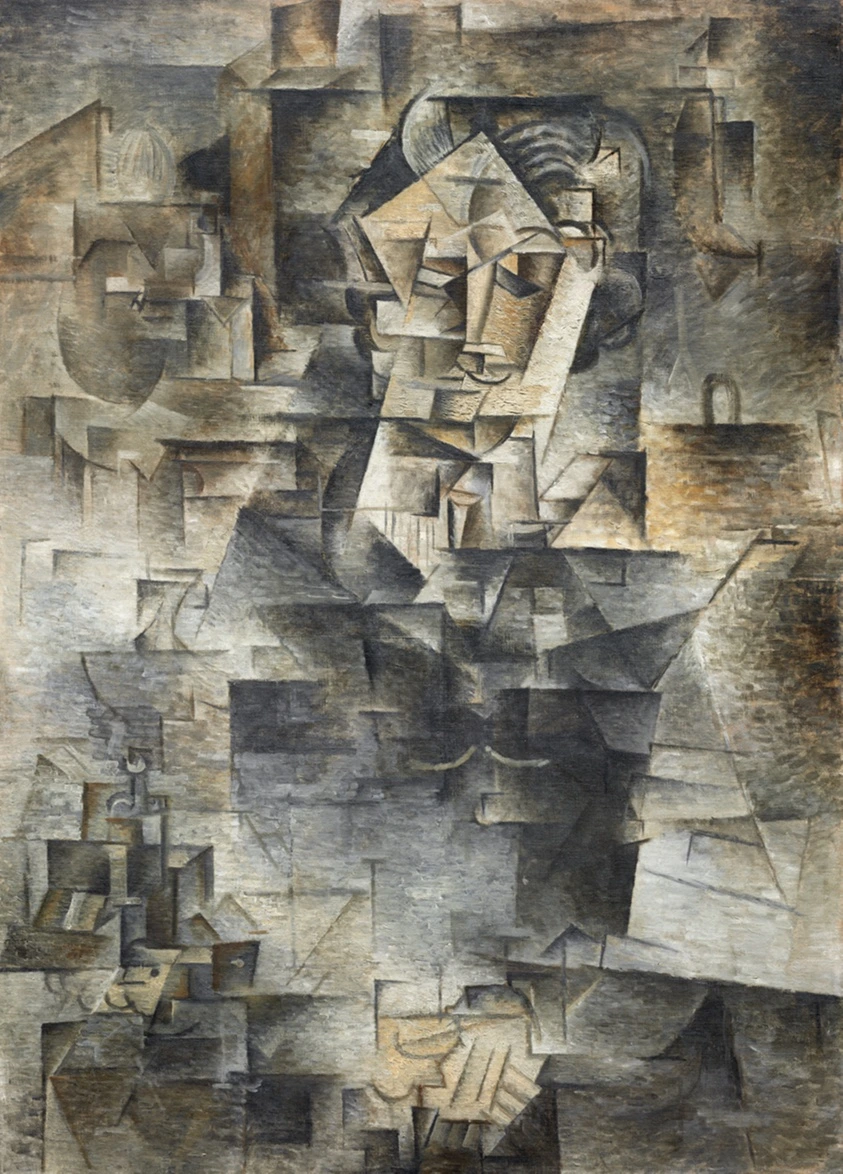
The subject of this portrait is Daniel-Henry Kahnweiler (1884–1979), a German-born art dealer, writer, and publisher. Kahnweiler opened an art gallery in Paris in 1907 and in 1908 began representing Pablo Picasso, whom he introduced to Georges Braque. Kahnweiler was a great champion of the artists’ revolutionary experiment with Cubism and purchased the majority of their paintings between 1908 and 1915. He also wrote an important book, The Rise of Cubism, in 1920, which offered a theoretical framework for the movement.

Kahnweiler sat as many as thirty times for this portrait. No longer seeking to create the illusion of true appearances, Picasso broke down and recombined the forms he saw. He described Kahnweiler with a network of shimmering, semitransparent surfaces that merge with the atmosphere around him. Forms are fractured into various planes and faceted shapes and presented from several points of view. Despite the portrait’s highly abstract character, however, Picasso added attributes to direct the eye and focus the mind: a wave of hair, the knot of a tie, a watch chain. Out of the flickering passages of brown, gray, black, and white emerges a rather traditional portrait pose of a seated man, his hands clasped in his lap.

Provenance

Daniel-Henry Kahnweiler (1884–1979), Paris, acquired directly from the artist; sold, Hôtel Drouot, Paris, June 13–14, 1921, 1st Kahnweiler sequestration sale, lot. 84, as Portrait, to Isaac Grünewald (1889–1946), Paris, to at least 1925 [letter from Daniel-Henry Kahnweiler, Sept. 30, 1975, in curatorial object file; Der Querschnitt 1925]. Earl Horter (1880-1940), Philadelphia, by c. 1929–1930 [Philadelphia 1999]; sold to Mrs. Charles Goodspeed (née Elizabeth Fuller, later Mrs. Gilbert W. Chapman; 1893–1980), Chicago, 1934 [letter from Mrs. Gilbert W. Chapman, Oct. 27, 1975, in curatorial object file]; given to the Art Institute of Chicago, Dec. 14, 1948.

Daniel-Henry Kahnweiler

Pablo Picasso

autumn 1910

Accession Number

111060

Medium

Oil on canvas

Dimensions

100.4 × 72.4 cm (39 9/16 × 28 9/16 in.)

Classification

oil on canvas

Museum

The Art Institute of Chicago

Chicago, United States

Credit Line

Gift of Mrs. Gilbert W. Chapman in memory of Charles B. Goodspeed
Background & Context

Background Story

Pablo Picasso's portrait of "Daniel-Henry Kahnweiler" (autumn 1910) is one of the defining works of Analytical Cubism — the revolutionary style that Picasso and Georges Braque developed between 1909 and 1912, in which three-dimensional objects were broken down into intersecting planes and multiple viewpoints, then reassembled on the two-dimensional surface of the canvas. The subject of the painting, Daniel-Henry Kahnweiler (1884–1979), was a German-born art dealer who became one of the most important figures in the history of modern art. Kahnweiler opened his gallery at 28 rue Vignon in Paris in 1907 and immediately began championing the most radical artists of the day. He was the first dealer to offer Picasso and Braque exclusive contracts (in 1909 and 1910 respectively), guaranteeing them a monthly income in exchange for rights to their entire output. This financial security allowed Picasso and Braque to pursue the radical artistic experimentation that resulted in Cubism — a style so revolutionary that most of the established art world rejected it completely. In this portrait, Picasso reduces Kahnweiler's features to a network of intersecting planes and angles that shimmer across the canvas in a monochromatic palette of browns, grays, and blacks. The face is identifiable — the high forehead, the deep-set eyes, the prominent nose — but only after sustained looking, as the forms dissolve and reform before the viewer's eyes. The portrait is not a single viewpoint but a synthesis of multiple viewpoints, as if Picasso had walked around his subject, observed him from every angle, and then combined all those observations into a single image. The painting demonstrates the key principles of Analytical Cubism. The subject is 'analyzed' into its constituent planes, which are then 'built up' (the 'synthetic' aspect) on the canvas surface. Space and form are no longer represented through the traditional device of linear perspective but through the interrelation of flat planes that suggest depth without actually depicting it. Background and foreground merge, solids become transparent, and the distinction between the object and the space around it dissolves. Kahnweiler later described sitting for Picasso: 'He would look at me intently, then paint. He never painted from the model — just from memory or by looking at me from time to time. He never drew me. He simply looked and painted.' This method of working from memory and observation rather than from a fixed viewpoint was fundamental to Cubism's break with the Renaissance tradition of perspectival representation. Kahnweiler himself would become Cubism's greatest advocate, writing the first major theoretical study of the movement ('The Rise of Cubism,' 1920) and defending it against the criticism and misunderstanding that it provoked.

Cultural Impact

Kahnweiler's support was essential to the development of Cubism — without his financial guarantees and promotional efforts, Picasso and Braque might never have been able to pursue their revolutionary experiments to their logical conclusions.

Why It Matters

This portrait of Picasso's dealer reduces a human face to a network of intersecting planes — a defining work of Analytical Cubism that demonstrates how Picasso and Braque dismantled five hundred years of perspectival representation.